All published articles of this journal are available on ScienceDirect.

Leadership-Driven Pathways to BIM Maturity: Integrating Transformational Dimensions in Latin American AEC Digital Transformation-A Scoping Review
 iD
Flávia de Souza Costa Neves Cavazotte2
iD
Rodrigo Goyannes Gusmão Caiado1
iD
iD
Flávia de Souza Costa Neves Cavazotte2
iD
Rodrigo Goyannes Gusmão Caiado1
iD
Authors Info & Affiliations
Abstract
Introduction
The adoption of Building Information Modelling (BIM) in Latin American Architecture, Engineering, and Construction (AEC) organisations remains uneven, as implementation barriers extend beyond technical proficiency to include organisational readiness and capability development gaps. Although leadership is recognised as a driver of digital transformation, the relationship between transformational leadership dimensions and BIM maturity stages remains underexplored.
Methods
This study conducted a scoping review using the Scopus database and PRISMA-ScR-guided screening procedures. Of the 576 initial records, 72 publications were retained for bibliometric mapping with Bibliometrix and VOSviewer, and 14 studies met eligibility criteria for qualitative synthesis through iterative coding. Bass and Riggio’s transformational leadership dimensions were cross-mapped against Succar’s three-stage BIM maturity framework.
Results
The review identified stage-sensitive leadership patterns across BIM maturity. Idealised influence and individualised consideration were salient in early adoption; intellectual stimulation became critical for process redesign and collaboration; and inspirational motivation gained strategic importance in advanced integration contexts. Bibliometric findings showed increasing interest after 2021 and a thematic shift from technical to organisational and human factors.
Discussion
These findings suggest that BIM maturity progression should be understood not only as a technological transition but also as a leadership-mediated organisational change process. Leadership behaviours appear to vary by maturity stage, particularly in contexts marked by institutional asymmetries and uneven capability development.
Conclusion
This study proposes an exploratory conceptual framework linking transformational leadership dimensions to BIM maturity stages. The framework provides a theoretically grounded basis for aligning leadership with maturity and supports future empirical validation across diverse AEC contexts.
1. INTRODUCTION
After 20 years of research, there are more than 120,000 indexed papers addressing problems with BIM deployment. However, evaluations by experts suggest that 60-70% of BIM initiatives fail to achieve the expected benefits [1]. This ongoing disparity between technological capabilities and organizational practices indicates the influence of variables outside software performance [2]. For instance, leadership practices determine how businesses adopt and change digital technologies [2, 3].
Increasing competition in the AEC sector is encouraging companies to embrace digital tools that enhance collaboration, decision-making, and operational efficiency [4]. In technological terms, BIM represents a transformative approach that fundamentally alters how information flows through project lifecycles [5]. However, our previous systematic review showed that most of the research thus far has focused on how to integrate technology, not on the behavioral factors that determine whether businesses move through maturity phases or remain at the same level of adoption [6, 7].
This study examines a specific theoretical gap: the lack of frameworks that link recognized leadership constructs to the continuous improvement intrinsic to BIM capacity development. Bass and Riggio's transformational leadership approach delineates established behavioral dimensions: idealized influence, inspirational motivation, intellectual stimulation, and individualized consideration [6]. However, previous applications in construction management have addressed leadership in a general manner, failing to associate specific characteristics with specific challenges in organizational development.
In Latin America, this difference is more significant than in other regions. Regional AEC sectors face numerous challenges, including resource scarcity, insufficient institutional cohesion, and cultural influences such as a significant power distance, which impact technology acceptance in ways distinct from practices in Northern Europe or North America [8, 9]. Our previous study on BIM critical success factors in Brazilian public organizations indicated that human and organizational attributes consistently exert greater influence on implementation outcomes than purely technical considerations [10, 11].
This study contributes to the existing body of knowledge in two respects. First, we expand transformational leadership theory into the BIM maturity domain by delineating the distinct manifestations of each behavioral component across several capacity levels, from initial tool adoption to collaborative integration and ultimately to network-level orchestration [6, 12]. Second, we put this theoretical extension into a prescriptive framework that gives AEC managers rules for determining how well leadership maturity is aligned and strategies for addressing identified misalignments [13, 14].
The methodological paradigm integrates bibliometric mapping of the leadership-BIM nexus with a qualitative synthesis of empirical patterns. It follows the principles of theory elaboration [13, 15], which proceeds from established constructs toward context-specific applications. This adds to ongoing efforts to close the long-standing gap between BIM’s technical capabilities and its organizational adoption. This is particularly relevant for Latin American professionals who are responsible for digital transformation but do not have ready access to tailored guidance.
2. THEORETICAL FRAMEWORK AND RESEARCH QUESTIONS
2.1. Transformational Leadership in Organizational Change Driven by Technology
Bass’s first definition differentiated transformational leadership from transactional leadership by examining the methods through which leaders cultivate follower commitment beyond transactional exchanges [16]. Transactional techniques depend on the trade of rewards based on performance [6, 17, 18]. Transformational leadership, on the other hand, works through psychological processes that push followers' motivation beyond their own self-interest and toward a shared goal. Ban and Riggio’s (2006) [6] later revisions identified four key features that meta-analytic research shows are indicators of success in organizations across many fields [19]. These traits have notably strong effects when an organization is undergoing strategic change [14].
Idealized influence operates through behaviors that signal trustworthiness and ensure congruence between the leader’s values and those of the organization [6, 20]. When leaders show their support for digital projects by making decisions about how to use resources and by getting personally involved instead of passing responsibility for change down through the hierarchy, this dimension is manifested in technology adoption contexts.
Inspirational motivation involves articulating compelling future visions that sustain effort during periods of difficulty [21, 22]. BIM transitions typically require years to complete; therefore, leaders must maintain workforce motivation even during temporary productivity declines associated with the learning curve.
Intellectual stimulation promotes the examination of conventional methods and the investigation of alternative approaches [23, 24]. This dimension is critical for overcoming procedural inertia since adopting BIM entails altering how work is done, not just switching tools.
Individualized consideration addresses the diverse needs and capabilities of followers by providing tailored support [25, 26]. Multidisciplinary project teams require differentiated training approaches, as team members possess varying levels of digital readiness.
Research conducted in practical environments demonstrates that transformational leadership is associated with outcomes such as the adoption of information systems, the improvement of digital skills, and diminished resistance to change [27, 28]. This body of research, however, regards leadership as consistently pertinent across implementation phases, neglecting the potential need for shifts in dimensional emphasis as organizations advance through capability tiers [6].
2.2. BIM Maturity as a Gradual Process of Organizational Growth
Succar's (2023) [12] maturity framework envisions BIM capability development as advancement through qualitatively different phases, rather than as ongoing enhancement along a singular dimension [3, 14]. This tiered approach is in line with the general theory of how people use technology, but it also reveals characteristics specific to the construction sector.
Stage 1 (Object-based Modeling) involves the transition from 2D drafting to parametric 3D modeling. This is usually exclusive to one field, thus it does not allow people from other fields to collaborate effectively [29]. At this point, organizations must contend with learning-curve challenges and resistance from professionals accustomed to established workflows [4, 10].
Stage 2 (Model-based Collaboration) extends BIM by enabling interdisciplinary collaboration and information sharing. The main issue shifts from individual skill development to establishing protocols for collaborative practice and knowledge exchange [23].
Stage 3 (Network-based Integration) includes cloud-based platforms enabling lifecycle connectivity, IoT integration, and digital twin capabilities that align with the ideas behind Industry 4.0 [5]. Organizations pursuing this stage face interoperability challenges when extending beyond enterprise boundaries [30].
Most maturity models are predominantly descriptive, meaning they only describe the characteristics of each stage and do not address the organizational factors, such as leadership behaviors, that enable progress [31]. Siebelink et al. clearly state that BIM maturity models do not elucidate the transition of firms from one level to another [31]. Although Succar’s three-stage taxonomy provides a useful analytical scaffold, organizational BIM capability development is rarely linear or uniform across the firm [14]. Organizations may exhibit hybrid maturity profiles, with advanced practices in some projects, departments, or functions while other units remain at earlier stages [6]. For this reason, the framework is intended to be applied at the organizational-unit or project-program level, and leadership may require the concurrent enactment of multiple stage-relevant behavioral configurations when maturity is unevenly distributed [29].
Existing maturity models are predominantly descriptive, concentrating on the characteristics of each stage rather than on the organizational conditions that enable progression, including the ways in which leaders influence development [31]. Siebelink et al. clearly state that BIM maturity models do not elucidate the transition of firms from one level to another [31].
2.2.1. Rationale for Selecting Succar's Maturity Framework
Several competing BIM maturity and adoption frameworks have been proposed in the literature, each offering distinct granularity and analytical foci. Notable alternatives include the NATSPEC BIM framework, which emphasizes national specification standards; the Indiana University BIM Proficiency Matrix, which assesses competency across multiple performance domains; Siebelink et al.'s [31] multi-level maturity model, which disaggregates organizational BIM capability into finer-grained tiers with attention to barriers at each level; and Ahmed and Kassem's [14] unified adoption taxonomy, which integrates macro, meso, and micro adoption perspectives into a comprehensive conceptual architecture.
We selected Succar's (2023) [12] three-stage model as the maturity scaffold for this study for three reasons. First, it is the most widely cited maturity framework in the construction management literature, with over 1,500 citations, providing a shared reference point that maximizes the framework's communicability and comparability with existing research. Second, its three-stage structure offers a parsimonious scaffold that is compatible with our four-dimensional leadership model, resulting in a manageable 4 × 3 cross-mapping matrix (Table 1). More granular frameworks with five or six maturity levels would require a substantially larger evidence base to populate the resulting cells with adequate empirical support, an evidence base that, as the confidence calibration in Table 1 demonstrates, does not yet exist even for a three-stage structure. Third, Succar’s (2023) [12] conceptual distinction between object-based modeling, model-based collaboration, and network-based integration maps onto qualitatively different organizational challenges-individual skill acquisition, cross-disciplinary process coordination, and ecosystem-level orchestration, respectively-that plausibly require different leadership configurations. This qualitative differentiation between stages is more analytically productive for our purposes than incremental scoring systems that treat maturity as a continuous variable.
| Dimension | Stage 1: Object-based Modeling | Stage 2: Model-based Collaboration | Stage 3: Network-based Integration |
|---|---|---|---|
| Idealized influence | Visible commitment, resource investment, and personal advocacy.Evidence: [32]. Confidence: High | Cross-disciplinary openness, knowledge sharing, boundary spanning.Evidence: [4]. Confidence: Moderate | Open innovation commitment, strategic inter-organizational partnerships. Evidence: [6]. Confidence: Moderate |
| Inspirational motivation | Articulation of attainable benefits, sustaining motivation through the learning curve. Evidence: [44], Confidence: High | Celebration of coordination successes, sustaining momentum through protocol conflicts. Evidence: [45]. Confidence: Moderate |
Comprehensive digital transformation vision integrating I4.0 technologies. Evidence: [33]. Confidence: Mod-Low |
| Intellectual stimulation | Questioning legacy routines, enabling organizational unlearning. Evidence: [36, 43]. Confidence: Moderate High |
Protocol experimentation over premature standardization, embedded in systemic support. Evidence: [31]. Confidence: Moderate | Championing disruptive innovation and emerging technologies. Evidence: [43]. Confidence: Moderate |
| Individualized consideration | Tailored training addressing differential digital skill levels. Evidence: [1]. Regional mod: [31]. Confidence: Moderate |
Role-specific collaborative competency development across disciplines. Evidence: [45], Confidence: Mod-Low |
Developing distributed leadership and communities of practice. Evidence: [43]. Confidence: Low |
Note: Confidence levels: HIGH = converging evidence from ≥3 studies with direct empirical support; MODERATE = 2+ studies with empirical or strong conceptual support; MOD-LOW = limited direct evidence, supported by extrapolation; LOW = single-study or purely conceptual basis.
We acknowledge, however, that the choice of maturity taxonomy is not neutral: the framework's behavioral specifications are indexed to Succar's stage definitions, and their applicability may differ if alternative maturity taxonomies are adopted. For instance, Siebelink et al.'s [31] model would introduce additional intermediate levels where leadership-maturity interactions could be further differentiated, while Ahmed and Kassem's [14] multi-scale taxonomy might reveal macro-institutional leadership factors not captured by our organization-level analysis. We encourage future researchers to test the proposed stage-leadership linkages using competing maturity definitions, thereby simultaneously validating the framework's robustness and extending its applicability across different conceptualizations of BIM capability development.
2.3. The Leadership-Maturity Interface: Present Comprehension and Deficiencies
Recent studies show that leadership is a key factor in the success of BIM implementation, often more important than technical issues [32, 33]. Effective leaders communicate BIM benefits, secure sustained resource allocation, manage resistance, and maintain momentum during organizational transitions [23].
Transformational leadership has been demonstrated to encourage new ideas, make workers better at using technology, and make it simpler for people from different areas to work together on BIM projects [1]. Conversely, the majority of research examines leadership broadly, lacking specificity on styles, dimensions, or behavioral mechanisms pertinent to BIM environments.
The literature does not elucidate how the four components of transformational leadership manifest differently at various phases of BIM maturity. Initially, idealized influence may play a crucial role in rendering BIM adoption plausible. But at Level 2, intellectual stimulation is required to encourage experimentation and collaborative problem-solving. Level 3 may need to utilize inspirational motivation and individualized attention to sustain innovation and manage large ecosystems with multiple enterprises. However, there is no paradigm in existing research that connects leadership behaviors to each level of BIM maturity. This indicates a gap between what leadership theory proposes and its practical application in organizational contexts [10, 34].
This gap is particularly pronounced in Latin America due to cultural differences, resource constraints, and distinct organizational structures compared to BIM-leading countries like the UK, USA, and Scandinavia [8, 9]. Higher power distance, collectivist orientations, and limited digital readiness can all make leadership more challenging. In developing countries, it is especially important to establish a framework that accounts for context and integrates transformational leadership with BIM maturity models. This study addresses this gap by suggesting a prescriptive matrix that connects BIM development phases with leadership traits.
2.4. Questions for Research
This investigation is guided by two inquiries [13].
RQ1: In what ways do the different parts of transformational leadership show themselves at different levels of BIM maturity?
This question examines the variations in idealized influence, inspirational motivation, intellectual stimulation, and individualized consideration contingent upon an organization's effectiveness [6]. We contend that problems unique to each stage-initial resistance at Stage 1, intricate coordination at Stage 2, and ecological orchestration at Stage 3-necessitate a comparable focus on leadership [12].
RQ2: What recommendations could promote the coexistence of transformational leadership and the enhancement of BIM maturity?
This question begins by discussing the situation and then offers useful advice by putting facts into a matrix that shows how leadership behaviors are linked to maturity goals [6, 12]. This methodology should help managers find areas where things aren't in sync and determine appropriate interventions [13].
3. METHODOLOGY
We utilized Arksey and O'Malley's [35] scoping methodology to create a comprehensive map of the literature addressing leadership in BIM implementation contexts. The search method used Boolean combinations: ("transformational leadership" OR "leadership styles" OR "leadership competencies" OR "leadership skills" OR "change management leadership") AND ("BIM" OR "Building Information Modeling" OR "Building Information Modelling") AND ("implementation" OR "adoption" OR "implementation strategies").
In addition to adopting Arksey and O’Malley’s scoping review framework [35], the reporting structure of this review follows the PRISMA Extension for Scoping Reviews. The purpose of this alignment is to enhance procedural transparency and replicability by explicitly documenting identification, screening, eligibility, and inclusion stages. Consistent with scoping review objectives, the aim was to map and synthesize conceptual and empirical patterns at the intersection of leadership and BIM maturity, rather than to assess intervention effectiveness or conduct meta-analytic aggregation.
Scopus served as the primary database due to its comprehensive coverage of construction management literature and its capacity to export structured metadata that could be used for bibliometric research. The search process retrieved 576 records. Screening was conducted sequentially in accordance with established scoping review procedures and structured under PRISMA-ScR reporting logic. The first stage involved technical and formal exclusions. Records were removed based on document type, language, and publication period. The temporal boundary was defined to capture contemporary BIM discourse following the consolidation of maturity models and the acceleration of digital transformation scholarship. This stage resulted in 453 retained records.
The second stage consisted of title and abstract screening. Articles were retained only when they demonstrated an explicit analytical connection between leadership constructs and BIM implementation, adoption, coordination, or maturity development. Studies referring to leadership merely as a peripheral critical success factor, without examining behavioral dimensions or mechanisms, were excluded. This screening reduced the corpus to 72 publications suitable for bibliometric mapping.
To enhance replicability, screening criteria were defined using explicit decision rules. A “clear analytical linkage between leadership and technology” was established when a study included at least one of the following: (i) research questions or hypotheses connecting leadership behaviors/styles to BIM implementation, adoption, coordination, or maturity; (ii) findings that treat leadership dimensions as explanatory drivers of BIM-related outcomes; or (iii) a conceptual account of mechanisms through which leadership shapes BIM-enabled digital transformation. Studies mentioning leadership only as a generic success factor, without behavioral or analytical development, were excluded.
During full-text assessment, “sufficient methodological transparency” required reporting at least three elements: (i) stated research design, (ii) described data sources/ sampling, (iii) identified analytical methods, and (iv) evidence or structured reasoning supporting conclusions. Manuscripts lacking methodological detail or relying mainly on normative claims were excluded. These definitions ensured that inclusion decisions followed reproducible, conceptually aligned criteria consistent with the exploratory purpose of the scoping review.
The third stage involved full-text eligibility assessment. Manuscripts were evaluated against three criteria: (i) explicit treatment of leadership behaviors or dimensions; (ii) identifiable BIM implementation or maturity context; and (iii) sufficient methodological transparency, including clear research design, data sources, and analytical procedures. Conceptual commentaries lacking analytical grounding were excluded. This process yielded a final corpus of 14 studies for qualitative synthesis and framework development.
The selection procedure is summarized in the PRISMA-ScR flow diagram presented in Fig. (1). To preserve readability in a two-column format while ensuring full transparency, the complete characterization of the 14 included studies is provided in Supplementary Material A. The detailed stepwise screening decision log, including operational definitions, rationales, and excluded/retained counts for each screening stage, is provided in Supplementary Material B and is aligned with Fig. (1).
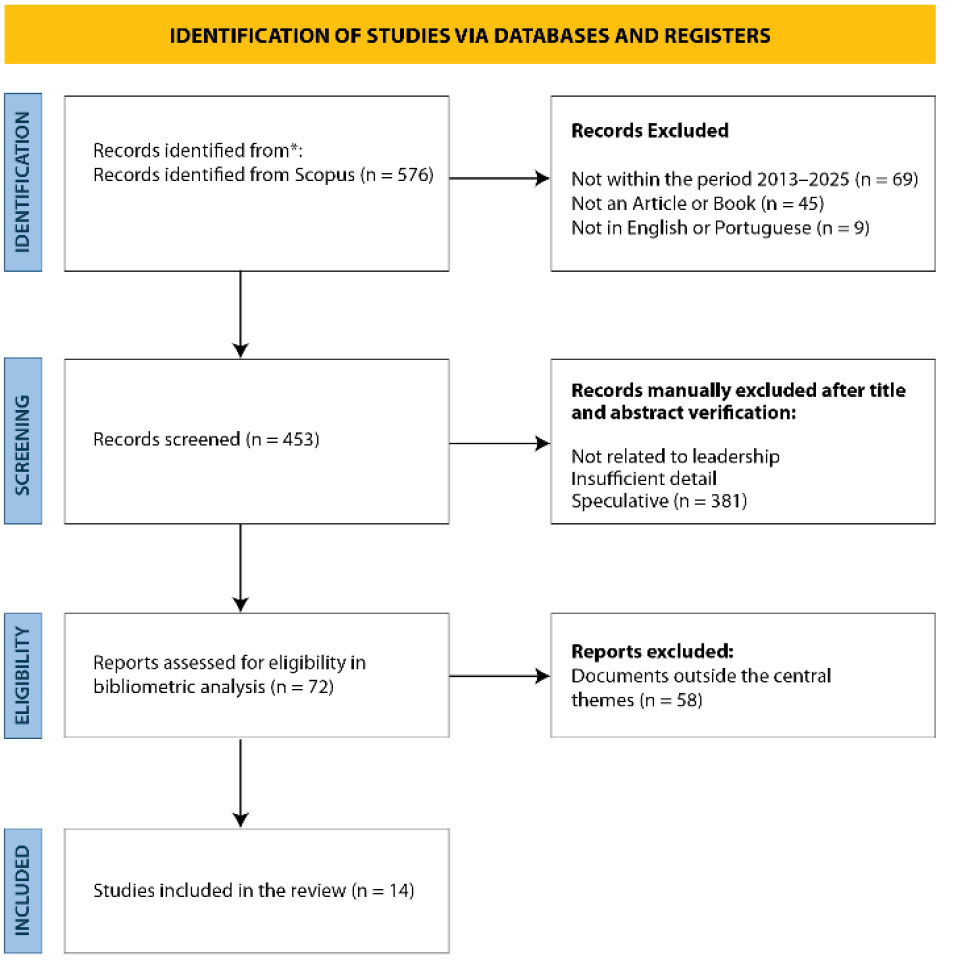
The identification and screening process utilizing the PRISMA model.
Source: Elaborated by the authors.
The full-text eligibility assessment applied two substantive criteria that determined inclusion in the qualitative synthesis corpus. Both criteria are operationalized below with explicit thresholds and worked examples to ensure replicability. Sufficient methodological rigor was operationalized as meeting at least three of four quality indicators: (i) an explicit research design statement, such as declaring a cross-sectional survey or multiple case study approach; (ii) a described data collection procedure, including sampling strategy, instrument description, or response rate; (iii) a stated analytical method, such as structural equation modeling, thematic analysis, grounded theory, or fuzzy-set qualitative comparative analysis; and (iv) reported validity or reliability measures, such as Cronbach's alpha, factor loadings, member checking, or triangulation. Studies that met only two of these criteria were independently reviewed by the authors and were only retained when the missing criterion was the measure of validity or reliability and the remaining three were described in sufficient detail.
For instance, Li et al. [36] met all four indicators: the study explicitly stated a structural equation modeling design, administered a structured questionnaire to 124 construction organizations with a described sampling procedure, employed covariance-based SEM as the analytical method, and reported Cronbach's alpha values above 0.70 for all constructs. Conversely, a conceptual commentary asserting leadership's importance in BIM adoption was excluded because it presented no described research design, data collection procedure, or analytical method.
The second criterion, substantive engagement with leadership in relation to BIM, required that a study's research questions, hypotheses, or core analytical findings explicitly addressed leadership behaviors, styles, competencies, or organizational mechanisms in the context of BIM or digital technology adoption. Studies in which leadership appeared only as a peripheral element-for example, as one item among many critical success factors in a ranked list without dedicated analysis of leadership mechanisms-were excluded.
To illustrate, Vu et al. [37] satisfied this criterion because their research question directly examines the influence of project managers' inspirational motivation leadership style on coordination and performance of BIM construction projects. In contrast, a survey study that ranked fifteen critical success factors for BIM implementation and listed top management support at the seventh position without further examination of what leadership behaviors constitute this support, through which mechanisms they operate, or how they differ across organizational contexts, was excluded.
Three nested corpora were generated through this procedure and are distinguished throughout the analysis. Corpus A (N = 453) comprises records remaining after exclusion by temporal range, publication type, and language, and is used for temporal trend analysis (Fig. 2). Corpus B (N = 72) consists of records retained after title and abstract screening and is used for bibliometric network and thematic visualizations (Figs. 3-7). Corpus C (N = 14) comprises studies retained after full-text eligibility assessment and is used for qualitative synthesis and conceptual framework development (Section 3.2.1 onward; Section 4.1). Each figure caption in Section 4 specifies which corpus it represents, ensuring analytical traceability.
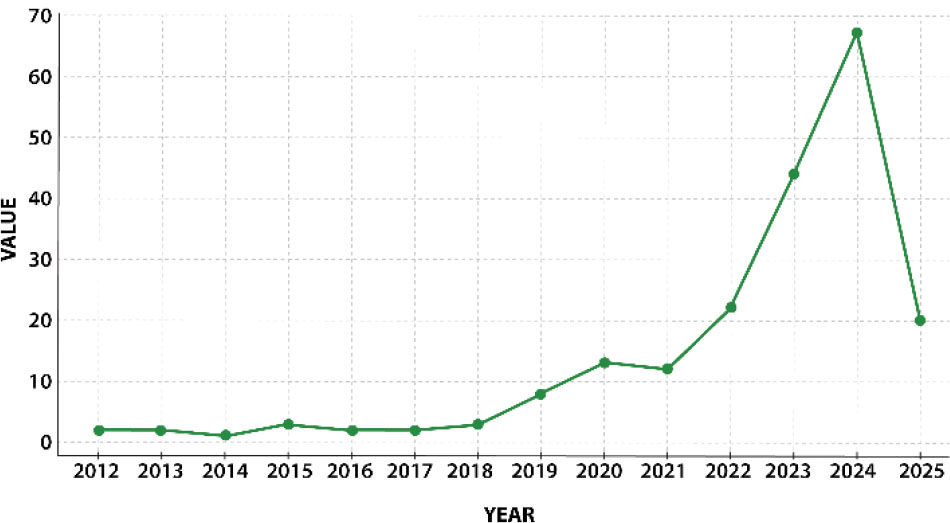
Annual publication volume at the leadership-BIM intersection (Corpus A, N = 453). Note: This figure represents the broader corpus after exclusion by temporal range, publication type, and language, prior to thematic screening. The peak of approximately 65 publications in 2024 reflects general academic interest; Corpora B (N = 72) and C (N = 14) are progressively focused subsets.
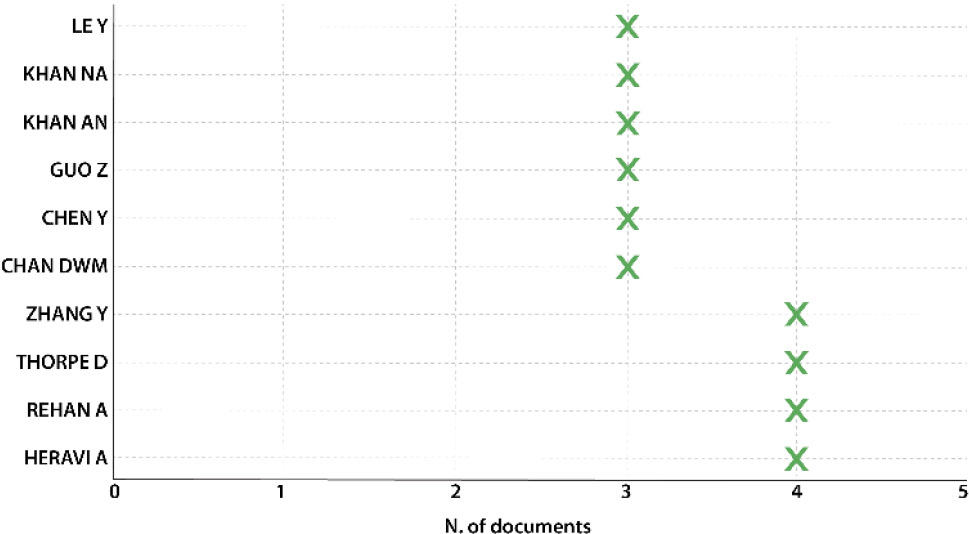
Number of articles that each author has written.
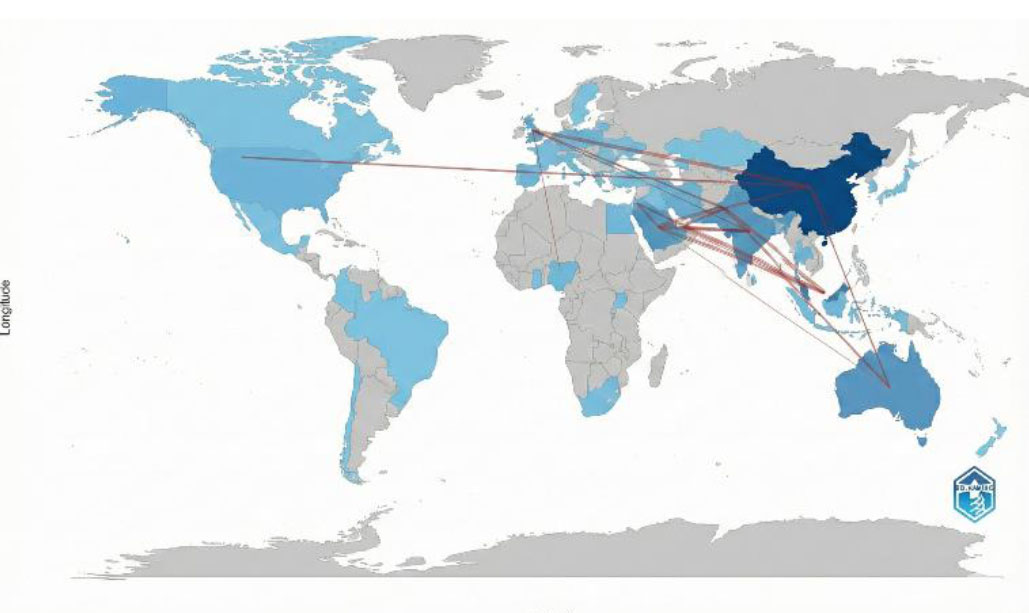
Map of cooperation between countries.
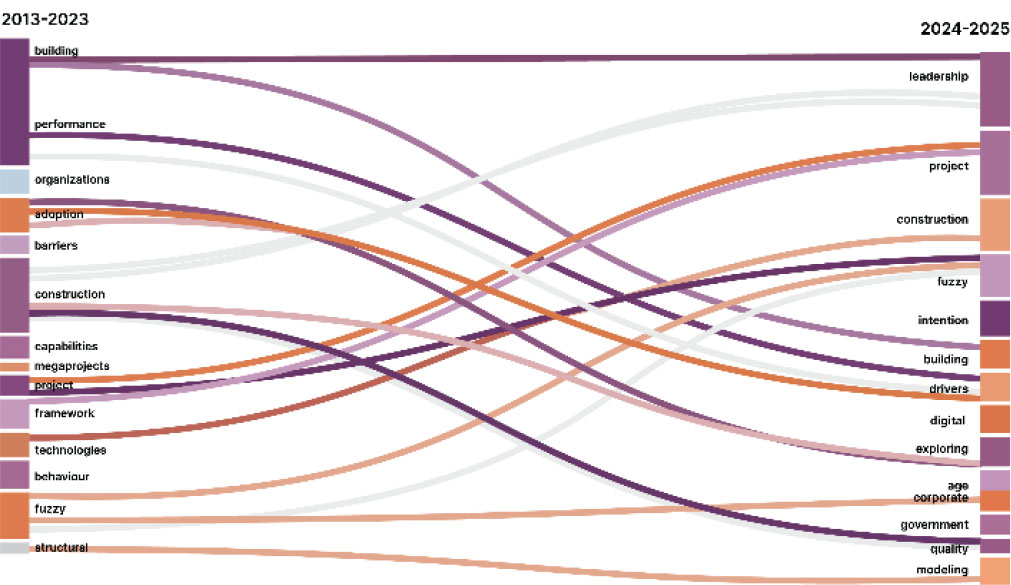
Sankey diagram of thematic progression.
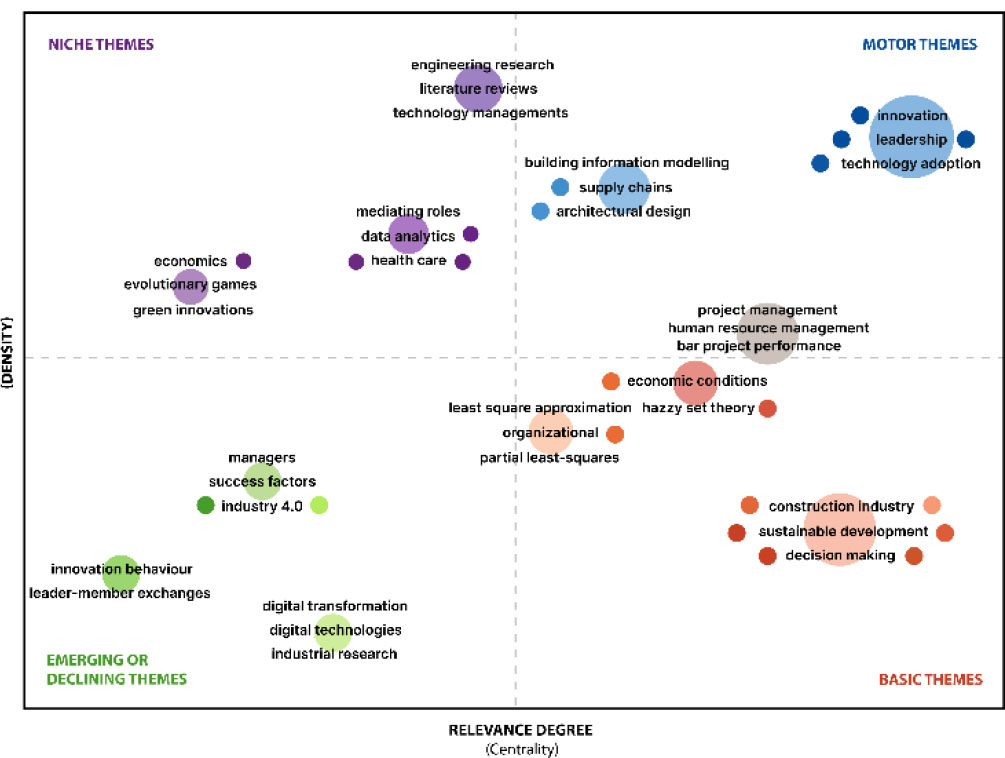
Source of the thematic map.
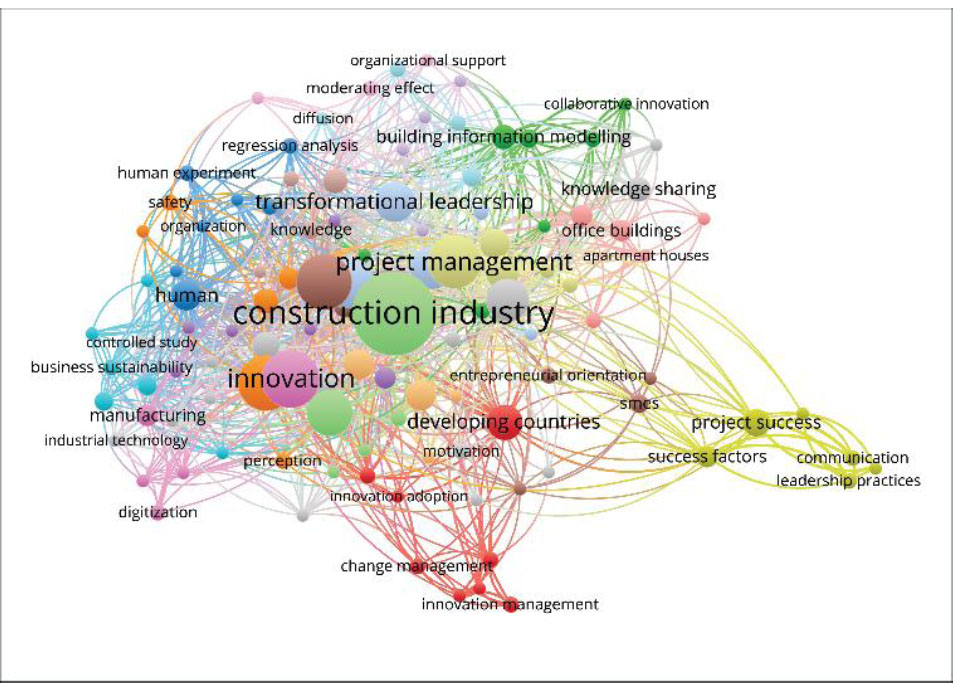
Thematic network.
3.1. Creation of Visualisations
After searching the Scopus database, the metadata for the selected articles was downloaded as CSV files. An R script was then used to combine the search results into a unified dataframe, from which duplicate records were removed to avoid distortion in the analysis. The cleaned dataframe was processed using the Bibliometrix package in R, a well-established tool for bibliometric analysis, to generate visualizations based on the metadata. These included maps of the most productive authors and journals, networks of international collaboration, and thematic maps. These visualizations facilitated examination of both historical and contemporary research on how transformational leadership might support BIM adoption in the AEC sector, with emphasis on organizational change management and technology implementation.
3.2. Qualitative Synthesis Procedure and Corpus Characterization
Full-text assessment applied the stricter inclusion criteria described above to the 72 bibliometrically mapped documents, eliminating 58 articles and resulting in a final set of 14 publications for qualitative synthesis and conceptual framework development. This size reflects the current state of scholarship at the intersection of transformational leadership theory and BIM capability development, two areas that have largely evolved separately. Rather than indicating a weak evidence base, this number highlights a genuine and documented gap: the literature has predominantly treated leadership and BIM maturity as separate issues. The 14 studies are treated as a foundation for theory building rather than testing, aligned with the exploratory goal of scoping reviews [35].
To ensure evidentiary traceability and analytical transparency, each included study is systematically documented in Supplementary Material A. The table reports, for every study: (i) authors and year; (ii) geographical and organizational context; (iii) methodological approach; (iv) sample or data characteristics; (v) leadership construct(s) examined; (vi) BIM maturity relevance; and (vii) the specific contribution to the stage-leadership mapping developed in this study.
To ensure full transparency while preserving readability in a two-column format, the complete characterization of the 14-study corpus is provided in Supplementary Material B. It reports, for each included study, the context, method, sample/data, leadership construct(s) examined, BIM maturity relevance, and the specific contribution to the proposed framework. Providing these details outside the main text enables readers to independently assess the evidentiary basis of the stage-leadership mapping and to identify areas where further empirical investigation remains necessary.
The consolidated corpus spans 10 countries across four continents, with methodological diversity encompassing: quantitative surveys and structural equation modeling (n = 5), qualitative case studies (n = 3), mixed methods with grounded theory or artificial intelligence (AI) modeling (n = 3), and systematic/scoping reviews with qualitative synthesis (n = 3). Temporally, 11 of the 14 studies (79%) were published between 2021 and 2025, ensuring that the framework is grounded in the most current scholarship. Geographically, the corpus includes studies from China (n = 3), Australia (n = 1), UK (n = 1), Nigeria (n = 1), South Africa (n = 1), Netherlands (n = 1), Brazil (n = 2), Chile (n = 1), Taiwan/Vietnam (n = 1), and multi-country designs (n = 1). The Latin American representation (n = 3: Brazil and Chile) is nascent; accordingly, Latin America is treated primarily as an application context and boundary condition, supported by the subset of regional studies and complementary regional literature, as discussed in Section 5.2.1.
3.2.1. Coding Procedure
A deductive-inductive coding protocol was employed. Initial codes were derived deductively from Bass and Riggio's [6] four transformational leadership dimensions (idealized influence, inspirational motivation, intellectual stimulation, individualized consideration) and Succar's [12] three maturity stages (object-based modeling, model-based collaboration, network-based integration). These formed the structural scaffold for the cross-mapping matrix. Inductive codes emerged during the analysis for contextual moderators, such as cultural power distance, resource scarcity, and institutional voids, as well as behavioral mechanisms, including credibility signaling, trust brokering, and protocol experimentation.
Each study was coded for: (i) leadership constructs addressed, (ii) BIM maturity stage relevance, (iii) organizational context and regional factors, (iv) key behavioral mechanisms identified, and (v) reported outcomes or theoretical arguments. Two authors (CADS and RGGC) independently coded all 14 studies. Initial inter-coder agreement was κ = 0.78, indicating substantial agreement per Bujang et al. benchmarks [38]. Twelve discrepancies were resolved through iterative discussion, and the third author (FSCNC) arbitrated three remaining cases. The most common source of disagreement involved the assignment of studies to specific maturity stages when the original study did not employ Succar's taxonomy. These cases were resolved by mapping the reported organizational BIM context to the closest-stage equivalent, based on the capability descriptions provided by Succar's [12].
3.2.2. Informational Adequacy Assessment
Thematic coding was performed iteratively, with studies processed in random order. After the eleventh study, no new stage-leadership linkages emerged from the remaining three studies. These final studies confirmed existing behavioral patterns without introducing novel configurations. We interpret this as informational adequacy for the exploratory purpose of this scoping review, while acknowledging that formal theoretical saturation, in the grounded theory sense, would require a larger and more diverse corpus with primary data collection. The small corpus size remains the principal limitation of this study and is discussed further in Section 5.3.
3.2.3. Handling of Contradictory Evidence
Contradictory findings across studies were not suppressed but systematically documented and integrated into the framework as contingency annotations. Three principal areas of disagreement were identified.
Regarding the relative primacy of leadership dimensions at Stage 1, the majority of studies [1, 4, 32, 36, 39] identified idealized influence, manifested as leader visibility and personal commitment, as the primary enabler of initial BIM adoption. However, study found that intellectual stimulation through organizational unlearning was the primary mediating pathway, suggesting that in organizations with pre-existing technical competence, questioning legacy routines matters more than leader visibility [36]. Study further demonstrated that Stage 1 barriers are predominantly individual-level resistance, which responds differentially to different leadership dimensions depending on the source of resistance, whether skill deficit or procedural inertia [31]. This contradiction was resolved by incorporating a moderating condition: the relative emphasis of leadership dimensions at Stage 1 appears contingent upon the organization's baseline digital capabilities and the dominant type of resistance encountered.
Concerning transactional versus transformational mechanisms at Stage 2, study provided robust empirical evidence that contingent reward (transactional) leadership was effective for establishing BIM coordination protocols [37], while Alankanage et al. [40] and Shojaei et al. [39] emphasized trust-based (transformational) approaches for cross-disciplinary collaboration. Study by Gao et al. [41], further demonstrated through fuzzy-set analysis that leadership support operates only in configurations with training and culture, not in isolation. This finding was incorporated as a boundary condition (Section 5.1): compliance-driven BIM mandates and coordination-intensive Stage 2 contexts may require transactional mechanisms that complement, rather than replace, transformational approaches.
With respect to cultural moderation of individualized consideration, studies from high power-distance and developing country contexts [4, 32, 42] suggested that individualized consideration manifests differently in collectivist versus individualist organizational cultures, operating through group-level mentoring, hierarchical endorsement, and institutional signals rather than one-on-one coaching. Study cultural depth analysis confirmed that the deepest cultural layer, basic assumptions, shapes how leadership behaviors are interpreted by followers [40]. This was incorporated as a regional moderation factor in the framework's Latin American contextualization (Section 5.2.1).
4. RESULTS
The analyses presented in this section draw on two distinct corpora as defined in Section 3. Corpus A (N = 453) resulted from formal exclusions based on document type, language, and publication period, and is used for temporal publication trends (Fig. 2). Corpus B (N = 72), comprising records that passed the thematic title-and-abstract screening, is used for the authorship, collaboration, thematic, and network visualizations (Figs. 3-7). Corpus C (N = 14), the qualitative synthesis corpus, is a subset of Corpus B and is not represented in the bibliometric visualizations; its role is confined to the conceptual framework development described from Section 4.8 onward. Each figure caption specifies which corpus it represents, ensuring analytical traceability throughout.
Figure 2 shows the first visualization, which depicts the number of articles published on transformational leadership in BIM implementation. The goal is to show how academic interest has changed over time and how this thematic intersection is becoming more important.
There has been a substantial increase in scientific research on transformational leadership in the context of BIM adoption. From 2013 to 2018, publication activity remained modest, with fewer than five articles appearing each year. A gradual increase began in 2019, and by 2021, publication volume accelerated markedly, reaching approximately 65 publications in 2024 within the broader bibliometric corpus. It is important to note that this figure refers to Corpus A (N = 453). The slight decline observed in 2025 likely reflects incomplete indexing for the current year rather than a genuine reduction in scholarly output. This trend demonstrates that the subject is consolidating as a recognized area of inquiry and that an increasing number of researchers acknowledge leadership as a critical component of the AEC sector’s digital transformation. This trajectory aligns with the global expansion of BIM adoption and the growing number of countries establishing BIM mandates.
Figure 3 shows the most productive authors in the corpus. Heravi stands out for investigating how different types of project manager leadership function in construction settings.
This research stream, published in journals such as the International Journal of Construction Education and Research, provides empirical evidence connecting leadership variation to project performance, findings that are directly pertinent to our theoretical extension.
Rather than evidencing a structural shift, the visualizations highlight the relative co-occurrence patterns between technological and organizational constructs within the analyzed publications. The observed prominence of leadership-related terminology suggests an increasing conceptual integration of human and governance dimensions within BIM discourse; however, the figures should be interpreted as descriptive mapping tools rather than confirmatory evidence of causal transformation.
Figure 4 illustrates the networks of countries that have partnered on research projects. China and Australia serve as the main hubs connecting to many other countries. Brazil’s connections to Portugal indicate that Latin America is becoming involved, but the region remains underrepresented relative to other regions.
Figure 5 illustrates the temporal evolution of keywords across the corpus. The 2013-2023 corpus focused on structural-technical terms like "building," "performance," "barriers," and "adoption". In 2024-2025, "leadership" gained prominence along with "project," "digital," and "intention." The diagram does not seek to validate term prevalence, but to illustrate how leadership-related constructs intersect with project governance, digital coordination, and organizational intention across the selected studies.
Figure 6 presents a thematic analysis that classifies research themes into four groups: “motor themes” (well-developed and central), “basic themes” (central but underdeveloped), “emerging or declining themes” (peripheral and underdeveloped), and “niche themes” (well-developed but peripheral). Frequently occurring themes include “construction industry,” “sustainable development,” and “decision making.” The primary ideas in the literature on leadership and BIM are “leadership,” “innovation,” and “technology adoption.” “Project management” and “human resource management” are positioned between the motor and core themes, indicating increasing significance.
Among the niche themes, “engineering research,” “literature reviews,” and “technology management” are well-developed but less central. The inclusion of “mediating roles” and “data analytics” in this cluster indicates methodological advancement. Emerging topics include “digital transformation,” “innovative behavior,” and “leader-member exchanges,” which connect the behavioral dimension of leadership to digital transformation.
Next, Figure 7 shows the thematic network, which shows how the relevant keyword terms are related to each other.
Network of Ideas. Figure 7 shows how keyword co-occurrence works. "Transformational leadership" is in the middle, linking groups that work on technical issues (BIM, technology adoption) with those that work on organizational issues (change management, innovation) [14]. This structural positioning indicates the construct’s capacity to connect previously disjointed discourse streams [43].
4.1. Conceptual Framework: Correspondence between BIM Maturity Stages and Aspects of Transformational Leadership
Based on a systematic study of the literature, we propose an integrative conceptual framework that links the four dimensions of transformational leadership with the BIM maturity levels delineated in [12]. The stage-specific behavioral configurations presented below are derived from patterns identified across the 14-study qualitative synthesis corpus (Supplementary Material A). Each leadership maturity alignment reflects either (i) convergent empirical findings reported in multiple studies, (ii) mechanism-based interpretations explicitly discussed in the literature, or (iii) contextually bounded extrapolations grounded in documented maturity-stage challenges. This approach ensures that the framework is anchored in traceable analytical sources rather than normative generalization.
Beyond structural alignment, the theoretical contribution of this study lies in the contextual re-specification of transformational leadership constructs within BIM implementation environments. While Bass [16] dimensions were originally articulated in organizational and motivational terms, their operational meaning shifts when embedded in digitally mediated, model-centric project ecosystems. In BIM-driven contexts, idealized influence becomes less associated with symbolic authority and more with credibility in digital governance and data integrity. Inspirational motivation extends beyond vision articulation to the orchestration of shared digital transformation narratives across fragmented project networks. Intellectual stimulation manifests not only as cognitive challenge but as the active promotion of collaborative problem-solving within interoperable modeling platforms. Individualized consideration, in turn, evolves from interpersonal mentorship toward capability-building in digitally intensive workflows.
By aligning transformational leadership dimensions with progressive BIM maturity stages, the framework offers a structured interpretation of how leadership constructs have been conceptually associated with digital capability development. The resulting configuration does not claim causal validation, nor does it prescribe universal behavioral mandates. Instead, it synthesizes recurring thematic patterns observed across the corpus and organizes them into a coherent analytical structure. Consequently, the matrix should be interpreted as a propositionally informed orientation device intended to guide future empirical research, rather than as a normative managerial instrument.
For each stage, we specify the proposed behavioral configuration, trace it to its evidentiary source(s) in the 14-study corpus, and assign a confidence level based on the strength and directness of the evidence. Table 1 provides the complete cross-mapping.
4.1.1. Stage 1. Pre-BIM to BIM Level 1 (Object-based Modeling)
4.1.1.1. Idealized Influence
When leaders exhibit idealized influence at this stage, they demonstrate visible personal commitment to the digital vision through resource investment and personal involvement, counteracting initial resistance to change. Olugboyega et al. [32] found leadership commitment to be the strongest predictor of BIM project success (SEM, N = 187), operationalized as visible resource allocation and personal advocacy. Brito et al. [4] confirmed this finding in Brazilian public organizations, where leadership commitment ranked among the top three critical success factors. Shojaei et al. [39] identified committed leadership and management as the first enabler among UK contractors, specifying strategic vision communication and dedicated resource deployment. Ozcan-Deniz et al. [42] corroborated the finding from a public client perspective in developing countries.
4.1.1.2. Inspirational Motivation
Leaders need to articulate attainable short-term benefits of BIM and maintain team motivation during the productivity dip inherent in the learning curve. Vu and Hsieh [44] empirically validated that the inspirational motivation dimension specifically enables BIM project coordination and performance (CB-SEM, N = 224). Gao et al. [41] reconceptualized resistance as a rational response to uncertainty, demonstrating that inspirational motivation reduces perceived risk by making future benefits tangible. Omer et al. [1] identified vision articulation as a constructive leadership behavior enabling early adoption.
4.1.1.3. Intellectual Stimulation
Leaders question established routines and encourage experimentation with digital tools, which is essential for overcoming procedural inertia since adopting BIM entails altering how work is done, not merely switching tools. Li et al. [36] demonstrated that transformational leadership's primary pathway to BIM implementation operates through organizational unlearning (β = 0.31, p < 0.01), the abandonment of legacy routines, which maps directly to intellectual stimulation. [43] found that the absence of intellectual stimulation was the primary barrier among SMEs.
4.1.1.4. Individualized Consideration
Leaders address team members' differential digital skill levels through tailored training rather than uniform capacity-building programs. Omer et al. [1] identified individual support as a constructive leadership behavior; Siebelink et al. [31] showed that Stage 1 barriers are primarily at the individual level, necessitating person-specific interventions. In high power-distance contexts [4, 32], individualized consideration operates through group-level mentoring and hierarchical endorsement rather than one-on-one coaching, a regional moderation incorporated in Section 5.2.1.
4.1.2. Stage 2. BIM Level 2: Model-based Collaboration
When organizations advance to model-based collaboration, the focus shifts from individual skill acquisition to cross-disciplinary process coordination. The leadership emphasis changes accordingly.
4.1.2.1. Idealized Influence
Leaders model cross-disciplinary openness, share knowledge beyond functional silos, and accept feedback from other disciplines. Papadonikolaki and Wamelink [23] demonstrated that inter-organizational BIM collaboration requires trust-based leadership and boundary-spanning behaviors. Alankarage et al. [40] showed, using Schein's model, that BIM culture at the espoused values level requires leaders who demonstrate collaborative norms.
4.1.2.2. Inspirational Motivation
Leaders celebrate coordination successes, such as clash detection savings and schedule improvements, and sustain momentum through inevitable protocol conflicts. Vu and Hsieh [44] showed that contingent reward leadership enhances BIM project performance through coordination effectiveness, with BIM maturity moderating this relationship. While contingent reward is transactional, the finding confirms that motivational mechanisms rewarding coordination achievements are critical at Stage 2. Han et al. [45] identified team reflexivity as a mediating mechanism, the capacity for collective self-assessment during collaboration.
4.1.2.3. Intellectual Stimulation
Leaders encourage experimentation with collaborative protocols rather than premature standardization, recognizing that optimal collaboration practices emerge from iterative trial. Siebelink et al. [31] demonstrated that Stage 2 barriers shift to process-level coordination problems. Gao et al. [41] showed through fuzzy-set Qualitative Comparative Analysis (fsQCA) that active BIM use requires configurations of leadership support with training, incentives, and organizational culture, suggesting that intellectual stimulation at Stage 2 must be embedded in systemic support structures.
4.1.2.4. Individualized Consideration
Leaders develop role-specific collaborative competencies, recognizing that architects, engineers, and contractors require different collaboration skills. Aladağ et al. [46] demonstrated that different AEC professions perceive BIM adoption factors differently, supporting role-specific leadership attention. Alankarage et al. [40] found that BIM culture at the basic assumptions level varies by professional discipline.
4.1.3. Stage 3. BIM Level 3: Integration based on Networks
In the digital transformation trajectory aligned with Industry 4.0 trends, transformational leadership manifests through strategically coordinated actions that extend beyond the focal organization.
4.1.3.1. Idealized Influence
Leaders commit to open innovation and build strategic partnerships across organizational boundaries. Olugboyega [43] identified developing partnerships vital for the business, both inside and outside, as a core BIM leadership capacity through grounded theory. Vass and Gustavsson [5] showed that Stage 3 challenges are institutional and ecosystem-level, requiring leadership that operates beyond the focal organization.
4.1.3.2. Inspirational Motivation
Leaders articulate a vision of comprehensive digital transformation integrating AI, IoT, and blockchain capabilities aligned with technological and business advancements. Diaz Schery et al. [33] identified the shift from technical to human-organizational discourse as the field matures, suggesting that Stage 3 requires visionary leadership capable of integrating technological and business innovation. Han et al. [45] identified team resilience as a mediator; the capacity to sustain performance under ecosystem complexity maps to Stage 3.
4.1.3.3. Intellectual Stimulation
Leaders champion disruptive innovation and the adoption of emerging technologies. Zuraik and Kelly [24] demonstrated that CEO transformational leadership creates innovation climates enabling both exploitation (Stage 2) and exploration (Stage 3).
4.1.3.4. Individualized Consideration
Leaders develop distributed leadership capabilities and foster communities of practice, shifting from providing individual support to cultivating others' leadership capacities. Olugboyega [43] identified impartiality in recruiting individuals for BIM leadership roles as a key capacity.
The confidence distribution across the 12 cells, four rated high or moderate-high, five moderate, and three moderate-low or low, honestly reflects the current evidence base. The diagonal pattern of decreasing confidence from stage 1 to stage 3 is consistent with the bibliometric finding that the leadership-BIM intersection is a maturing but still developing field. The cells rated moderate-low and low represent priority targets for future empirical investigation, as discussed in section 5.3.
Figure 8 provides a synthesized graphical representation of the conceptual framework derived from the preceding analytical steps. It does not introduce new data, nor does it function as empirical validation. Instead, it integrates the relational and configurational insights discussed throughout Section 4 into a coherent visual schema intended to enhance interpretative clarity.
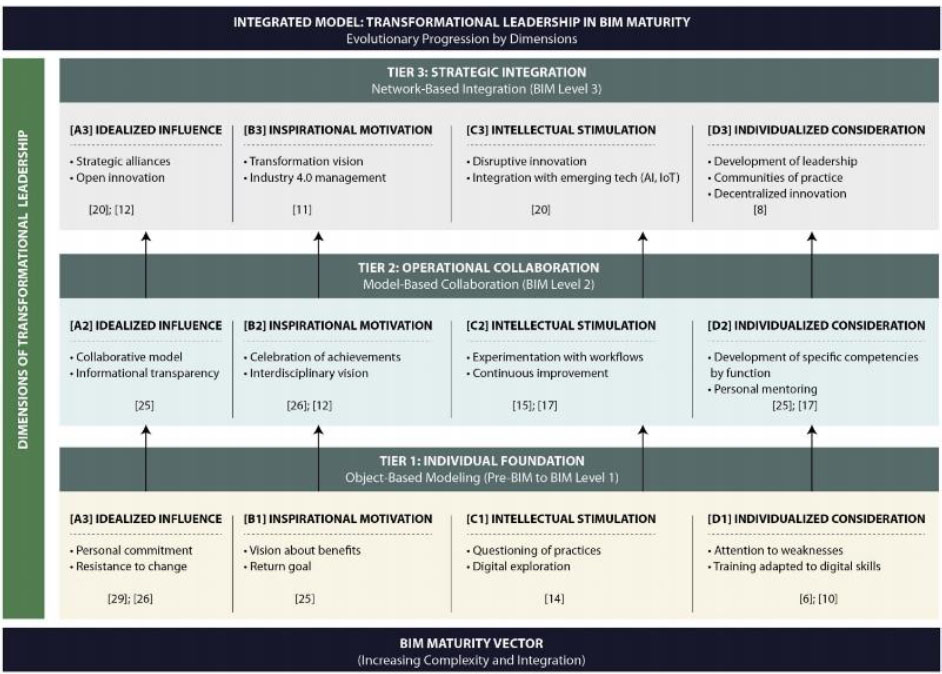
Conceptual framework: alignment between BIM maturity stages and dimensions of transformational leadership.
5. DISCUSSION
5.1. Contributions to Theory
The bibliometric analyses presented in Section 4 serve a contextual and field-characterizing function: they map the thematic landscape, identify temporal trends, reveal collaboration structures, and locate gaps in the existing discourse. These descriptive field trends contextualize and motivate the study’s research questions but do not, in themselves, validate the proposed framework. The qualitative synthesis (Section 3.2, Corpus C) constitutes the actual evidential basis for the conceptual framework. Accordingly, the framework’s credibility rests on the strength of the qualitative synthesis and its evidence-tracing procedures (Sections 3.2.1-3.2.3), not on the bibliometric patterns.
This study proposes an exploratory integration of transformational leadership theory into the BIM maturity domain by identifying how established behavioral dimensions may manifest differently across capability development phases. Past applications in construction management have predominantly emphasized leadership, presuming that good leadership behaviors are invariant across varying levels of organizational competency. Our framework contests this notion, suggesting that dimensional emphasis should vary between developmental phases. The contribution adheres to the theory elaboration process [19], transitioning from established concepts to context-specific applications. We do not suggest new leadership dimensions; instead, we elucidate how current dimensions manifest differently across several organizational contexts. This illustrates the elaboration pathway advocated for the application of general theories to specific domains.
We are explicit about what this study does not accomplish: it does not introduce new leadership constructs, it does not provide direct empirical validation, and it does not establish causal mechanisms between leadership behaviors and maturity transitions. Its contribution is configurational, specifying how existing, well-established constructs may manifest differently across a contextual gradient (BIM maturity stages) and thereby generating testable propositions for subsequent research.
Several bibliometric findings reinforce the theoretical positioning of the proposed framework. The post-2021 acceleration in publication volume (Fig. 2) provides temporal context for the evidence base: 11 of the 14 studies in Corpus C (79%) were published between 2021 and 2025, confirming that the leadership-BIM intersection is an actively developing field. The concentration of productivity among a small number of authors (Fig. 3) indicates that this intersection has not yet developed a broad specialist community, reinforcing its characterization as emerging rather than consolidated. The thematic migration from technical-structural terminology to human-organizational vocabulary (Fig. 5) provides bibliometric support for the study’s core premise that BIM capability development is mediated by behavioral factors. The central bridging position of “transformational leadership” in the co-occurrence network (Fig. 7) provides structural evidence that this construct serves as a conceptual connector between technical and organizational dimensions, precisely the integrative function the proposed framework operationalizes. Furthermore, the classification of “leadership” as a basic rather than motor theme (Fig. 6) indicates that while the topic appears frequently, it remains conceptually underdeveloped, consistent with our argument that leadership in BIM research has been treated generically rather than with dimensional specificity.
5.2. Practical Implications
The framework offers AEC professionals a preliminary diagnostic lens for assessing leadership-maturity alignment, contingent upon future empirical validation. Managers may assess organizational maturity, determine whether executive behaviors align with institutional principles, and identify areas requiring improvement. This contribution differs from most descriptive maturity models in that it adopts a prescriptive orientation that explains stages while also specifying recommended actions.
The framework integrates findings from the thematic map and the term co-occurrence network, confirming that leadership, technology adoption, and digital transformation are interconnected and mutually reinforcing constructs. As stated, the cultural change that must occur for BIM to work well does not happen spontaneously; it requires leaders who can motivate change, stimulate new ideas, and address individual needs during the transformation process [11, 47]. Papadonikolaki and Wamelink [23] suggest that the success of BIM deployment depends more on the leaders’ ability to manage the many interactions between people, processes, and technologies than on the technology itself.
This framework serves as a strategic tool for assessing and enhancing leadership capabilities in the Latin American AEC sector, calibrated to BIM maturity levels. The framework can be adapted to meet the cultural and organizational needs of the region, serving as a planning tool to facilitate sustainable digital transformation aligned with local contexts.
5.2.1. Regional Contextualization: Latin America as an Application Context
Although the framework is structurally generalizable, its interpretative grounding reflects implementation dynamics frequently observed in Latin American contexts, where BIM diffusion often progresses through public mandates and incremental private-sector adoption [48]. In such settings, leadership functions extend beyond internal organizational transformation and include inter-organizational coordination, capability bridging, and institutional alignment [43]. This contextual emphasis does not alter the theoretical architecture of the model but informs its practical interpretation under conditions of regulatory heterogeneity and resource asymmetry, characteristics commonly reported across Latin American construction ecosystems.
The peripheral position of Latin American countries in the collaboration network (Fig. 4) directly supports this contextual rationale: the region is an active yet underrepresented participant in global leadership-BIM discourse. The Brazil-Portugal collaboration axis indicates that knowledge transfer occurs along linguistic-cultural corridors rather than geographic proximity, which has implications for how the proposed framework might diffuse in the region.
Cultural characteristics, such as higher power-distance norms and collectivist inclinations, may influence how leadership behaviors are enacted and interpreted by followers, particularly during early-stage adoption and cross-functional integration. Under these conditions, transformational leadership can operate through visible endorsement, institutional signaling, and collective capability-building practices rather than purely individualized or highly participatory modes. The framework, therefore, supports localized tailoring by treating regional cultural factors as boundary conditions that shape the expression (not the existence) of leadership dimensions across maturity stages.
Accordingly, the Latin American focus is positioned as an intended application context rather than a claim that the framework was inductively derived from regional evidence alone. Future empirical validation within Latin American organizations is expected to test how these contextual moderators affect the feasibility and effectiveness of the proposed stage-specific configurations, and to refine the model based on practice-based evidence.
5.3. Study Limitations and Future Directions
Several limitations must be acknowledged. First, the approach is based on a synthesis of existing material rather than direct empirical testing. Bibliometric evidence substantiates the theoretical framework; however, empirical validation via organizational case studies is essential. Second, Scopus coverage may not include enough practitioner-oriented venues and non-English scholarship, which could make the evidence base lean toward academic views and Anglo-European contexts. Third, the framework treats maturity stages as separate groups, while in fact, firms probably go through progressive changes and have different skills in different areas. Future research should focus on three areas: (1) validating case studies within Latin American organizations at different maturity levels to determine if prescribed leadership behaviors promote advancement; (2) developing quantitative tools for the systematic evaluation of leadership-maturity alignment; and (3) conducting longitudinal studies to monitor the progression of leadership behaviors as organizations move through capability stages.
CONCLUSION
This study examined BIM implementation through the lens of transformational leadership theory and proposed an exploratory conceptual framework that aligns transformational leadership dimensions with BIM maturity progression levels. The contribution is theoretical and configurational: it synthesizes existing evidence into a stage-sensitive structure that serves as a proposition-generating orientation rather than claiming empirically validated behavioral prescriptions.
Through bibliometric mapping and qualitative synthesis, we characterized the field’s thematic evolution toward human-centered approaches and proposed stage-specific leadership configurations that previous research had not systematically examined. The framework clarifies how leadership mechanisms may be configured across maturity stages and highlights boundary conditions, particularly when applied in institutionally heterogeneous contexts.
Three principal findings emerged. First, bibliometric evidence demonstrates that scholarly interest in the leadership-BIM intersection has expanded substantially since 2021, with thematic analysis indicating a shift from technology-centered to organizational discourse. Second, collaborative network analysis reveals that Brazil is emerging as a regional hub for this subject, although Latin American representation remains limited compared to established research centers. Third, transformational leadership occupies a central bridging position in the thematic network, connecting behavioral and technological research streams.
AEC managers can use this framework to identify misalignments and select appropriate interventions at each stage of organizational development. Rather than addressing leadership generically, the framework specifies how idealized influence, inspirational motivation, intellectual stimulation, and individualized consideration should evolve across the stages of initial adoption, collaborative integration, and network-level orchestration.
Future research should empirically test these propositions through multi-case, longitudinal, and quantitative designs to strengthen external validity and refine the stage-specific configurations. The most important implication is that digital transformation requires more than technological investment; it also requires leaders capable of supporting sustained organizational development.
AUTHORS’ CONTRIBUTIONS
The authors confirm contribution to the paper as follows: C.S., R.C.: Study conception and design, Analysis and interpretation of results, Draft manuscript; C.S.: Data collection; F.C.: Critical revision for intellectual content. All authors reviewed the results and approved the final version of the manuscript.
LIST OF ABBREVIATIONS
| BIM | = Building Information Modelling |
| AEC | = American Architecture, Engineering, and Construction |
AVAILABILITY OF DATA AND MATERIALS
The data supporting the findings of this study are available from the corresponding author [C.S] upon reasonable request.
FUNDING
This research was funded by the National Council for Scientific and Technological Development (CNPq), Brazil, Funder ID: 10.13039/501100003593, Grant numbers: 307173/2022-4, 405734/2023-9, and 442384/2023-8; the Carlos Chagas Filho Foundation for Research Support of Rio de Janeiro State (FAPERJ), Brazil, Funder ID: 10.13039/501100004586, Grant numbers: E-26/201.363/2021 (260426) and E-26/204.408/2024 (297945); and the Coordination for the Improvement of Higher Education Personnel (CAPES), Brazil, Funder ID: 10.13039/501100002322, Finance Code 001.
CONFLICT OF INTEREST
Dr. Rodrigo Caiado is the Editorial Board Member of The Open Construction & Building Technology Journal.
ACKNOWLEDGEMENTS
The authors thank the Tecgraf Institute of Technical-Scientific Software Development of PUC-Rio (Tecgraf/ PUC-Rio), Brazil for its institutional support.