All published articles of this journal are available on ScienceDirect.

Artificial Intelligence in Construction Delay Analysis and Management: A Review
 iD
Putri Zulaiha Razi1
iD
Ramadhansyah Putra Jaya1
iD
Ummu Najwa Nur Yusrizal1
iD
iD
Putri Zulaiha Razi1
iD
Ramadhansyah Putra Jaya1
iD
Ummu Najwa Nur Yusrizal1
iD
Authors Info & Affiliations
Abstract
Introduction
Construction delays remain a challenge in projects, often resulting in cost overruns, disputes, productivity losses, and schedule inefficiencies. Growing project complexity has increased the need for data-driven approaches to delay analysis and management. This study reviews the application of artificial intelligence in construction delay analysis and management by examining application areas, techniques, project contexts, implementation maturity, and research gaps.
Methods
A structured literature review was conducted using a PRISMA-guided search and screening process. Scopus and Web of Science were searched for studies published between 2021 and 2025. Following database filtering, title and abstract screening, and full-text eligibility assessment, 42 studies were retained for qualitative synthesis.
Results
The reviewed studies applied artificial intelligence to delay prediction, delay-cause identification, risk prioritisation, progress monitoring, schedule recovery, and optimisation using machine learning, deep learning, ensemble learning, and hybrid modelling approaches. Several studies reported predictive accuracy above 90%, particularly for artificial neural networks, ensemble techniques, and hybrid optimisation models. However, evidence remains constrained by limited datasets, project-specific applications, weak real-time data integration, and insufficient consideration of contractual and external factors.
Discussion
The reviewed studies indicate that Artificial Intelligence (AI) models have improved predictive capability in construction delay management. However, practical implementation remains limited by data availability, model interpretability, and weak integration with project decision-making processes.
Conclusion
Artificial intelligence can improve construction delay management through transparent and data-driven approaches. Further research is needed to develop integrated frameworks linking predictive analytics with practical delay-management decisions in dynamic construction environments.
1. INTRODUCTION
Construction delays remain a common problem in projects worldwide and often result in cost overruns, disputes, productivity losses, and dissatisfaction among stakeholders [1, 2]. In many cases, delays arise from several causes occurring simultaneously. These may include design changes, poor planning, financial difficulties, adverse weather conditions, shortages of labour or materials, payment issues, poor coordination, and communication failures between project parties [3-6]. Since construction activities occur in dynamic environments and involve considerable uncertainty, delay management remains challenging throughout the project lifecycle [7, 8].
Delay analysis in practice has traditionally relied on expert judgement, retrospective review, scheduling methods, and manual examination of project records. Although these methods remain widely used, they can be time-consuming and may not fully capture the complex relationships present in modern construction projects. As projects become larger and more data-intensive, interest in intelligent tools for delay management has increased [9, 10].
Recent studies indicate that artificial intelligence can support delay prediction, risk analysis, schedule control, and project decision-making [11-16]. Machine learning, deep learning, ensemble methods, and hybrid models have reported encouraging results across different project settings [17-20]. Study [21] reported that Adaptive Boosting produced encouraging results in estimating delays in tunnelling works. In [22], neural network models were introduced to support schedules that could be adjusted following disruption. Meanwhile [23], integrated machine learning with multi-criteria decision analysis to examine delay sources and their effects on project completion time. Several other studies also discussed interpretable analytics, optimisation procedures, and ensemble techniques as decision-support tools for construction management [24-27].
Despite these developments, significant gaps remain in the published literature. Many studies rely on limited datasets or information derived from a single project environment. Some are confined to one country, while others focus primarily on comparing predictive accuracy without demonstrating how model outputs can support practical delay-management decisions [28-30]. Limited attention has also been given to live site data, lifecycle monitoring, digital reporting platforms, and broader organisational or environmental factors [31-33].
Recent publications suggest that AI is being applied across an increasingly diverse range of construction activities. Examples include delay-risk assessment for tall-building projects [34], prefabricated construction [35], dam projects [36], and public-sector construction projects [37]. This trend indicates that AI applications are progressively extending into specialised project environments rather than remaining confined to conventional building works. However, the literature remains insufficiently synthesised in terms of how AI applications differ across project contexts, the maturity of their implementation, and the extent to which reported models have progressed beyond experimental or project-specific use.
For this reason, a structured review of recent studies is needed. This paper presents a structured review of artificial intelligence applications in construction delay analysis and management. Using a PRISMA-guided search and screening process, this review maps the principal application areas, examines commonly adopted techniques, discusses existing limitations, and identifies future pathways for more effective and transparent construction delay management [38].
2. METHODOLOGY
2.1. Review Design
This study conducted a structured literature review to identify, evaluate, and synthesise published evidence concerning artificial intelligence applications in construction delay analysis and management. This approach was selected because it provides a structured and transparent method for retrieving, screening, and synthesising relevant studies [39]. The review employed a PRISMA-guided search and screening process to strengthen methodological transparency and reporting quality. The review process comprised the formulation of the review question, database searching, screening, eligibility assessment, data extraction, and synthesis of findings. This review was not registered with PROSPERO, as it focuses on artificial intelligence applications in construction delay analysis and management and therefore falls outside the principal health-related scope of the PROSPERO registry.
2.2. Review Question
The review was designed to address the following question:
RQ: What application areas, techniques, project contexts, implementation maturity, and research gaps characterise the use of artificial intelligence in construction delay analysis and management?
2.3. Identification
To identify relevant studies on the use of artificial intelligence in construction delay analysis and management, this research employed a structured literature review using a PRISMA-guided search and screening process.
Scopus and Web of Science were selected as the two primary databases because the review topic lies at the intersection of construction engineering, project management, and artificial intelligence. Both databases provide broad multidisciplinary coverage encompassing engineering, computer science, and management research and support structured, reproducible field-based searches. Their combined use therefore enabled the review to capture literature across the principal disciplinary areas relevant to construction delay analysis and AI applications while maintaining a consistent search, filtering, export, and duplicate-checking process. The use of predefined eligibility criteria across records retrieved from both databases also supported a consistent screening and selection process throughout the review. Nevertheless, the restriction to two databases may have excluded relevant studies indexed exclusively in other databases, and this is acknowledged as a methodological limitation.
Although the search strings were not identical, both were structured around the same core concepts of artificial intelligence, construction, and delay or time performance. The wording was adapted to the database-specific search fields and indexing structures. Scopus was searched using the TITLE-ABS-KEY field and included a broader range of AI-related and construction-related synonyms. Web of Science was searched using the TS field and included additional outcome-oriented terms, such as analysis, prediction, forecasting, management, and mitigation, to retrieve records relevant to construction delay analysis and management. The complete search strings used in each database are presented in Table 1.
| No. | Database | Search String |
|---|---|---|
| 1. | Scopus | TITLE-ABS-KEY((“artificial intelligence” OR “machine learning” OR “deep learning” OR “neural network*” OR “expert system*” OR “fuzzy logic” OR “genetic algorithm*” OR “support vector machine*” OR “data mining” OR “predictive model*”) AND (construction OR “construction project*” OR “construction industry” OR “infrastructure project*” OR “building project*”) AND (delay OR “project delay*” OR “schedule delay*” OR “time overrun*” OR “construction delay*” OR “delay analysis” OR “delay management” OR “schedule performance” OR “time performance”)) |
| 2. | Web of Science | TS = ((“artificial intelligence” OR “machine learning” OR “deep learning” OR “neural network*”) AND (“construction project*” OR construction OR “civil engineering”) AND (“delay” OR “time overrun” OR “schedule delay” OR “project delay” OR “schedule overrun”) AND (analysis OR prediction OR forecasting OR management OR mitigation)) |
The search in Scopus first returned 2,179 records through keywords related to artificial intelligence in construction delay analysis and project management. Several limits were then applied. Only papers from Engineering, Computer Science, and Business, Management and Accounting were kept. The publication years were set from 2021 until 2025. Only articles, review papers, and English-language documents were accepted. After these limits, 618 records remained for screening.
239 records were retrieved in Web of Science using similar keywords. The results were then filtered for publication from 2021 to 2025 only, articles and review papers, and limited to the English language only. Relevant categories such as Engineering, Computer Science, and Construction and Building Technology were also retained. After applying these filters, 68 Web of Science records remained for screening.
2.4. Screening
The screening stage aimed to identify studies directly relevant to the use of artificial intelligence in construction delay analysis and management. Inclusion and exclusion criteria were established in advance to ensure that only relevant and eligible studies were retained. The screening decisions were reviewed by the research team, and uncertain cases were resolved through discussion and consensus. The complete study identification and selection process is illustrated in Fig. (1).
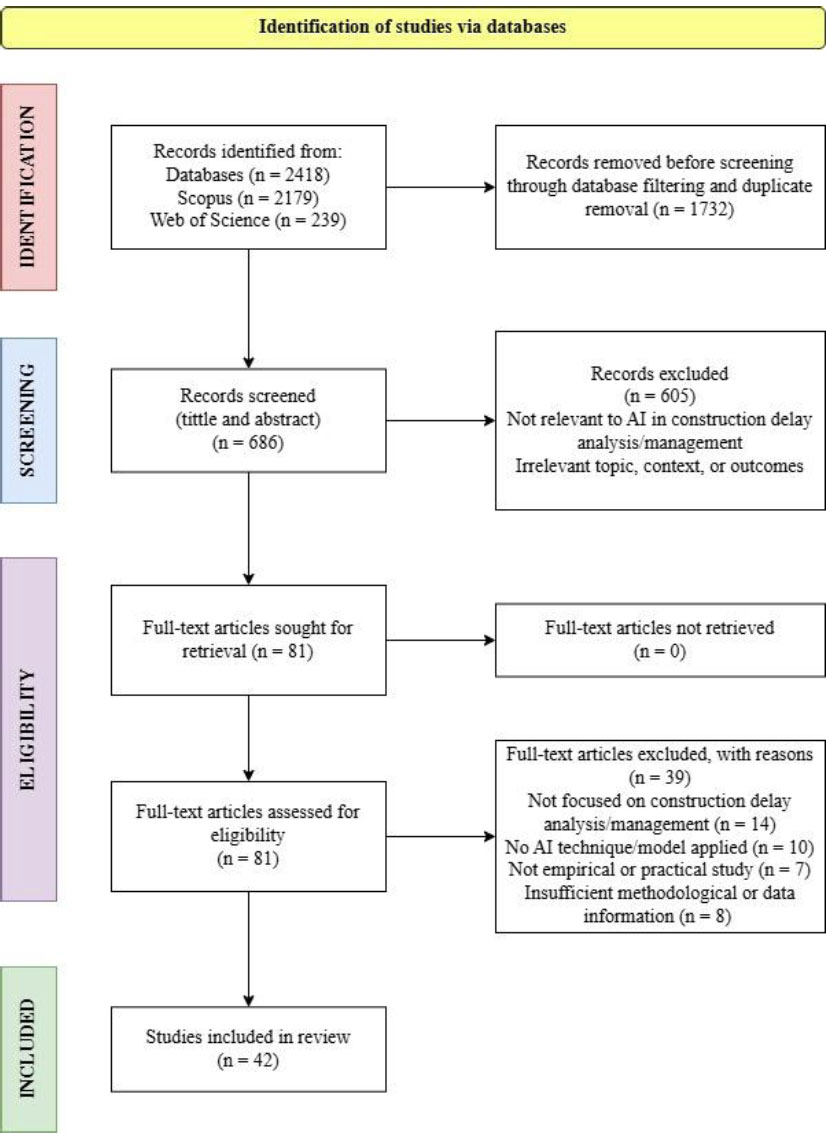
PRISMA 2020 flow diagram for the study identification and selection process. The diagram illustrates the identification of records from Scopus and Web of Science, database filtering, duplicate checking, title and abstract screening, full-text eligibility assessment, reasons for exclusion, and the final inclusion of 42 studies.
2.5. Eligibility Assessment
After the screening process, the remaining papers moved to the full-text review stage to confirm whether they were appropriate for final inclusion. During this stage, each study was read carefully and checked against the review objectives, clarity of research method, adequacy of reported information, and availability of the complete article.
Studies were excluded when artificial intelligence was mentioned only in general terms without a direct link to construction delay analysis or management. Papers with unclear methods, weak application context, or unavailable full text were also removed. The inclusion and exclusion criteria applied during the eligibility assessment are summarised in Table 2.
| Inclusion Criteria | Exclusion Criteria |
|---|---|
| Studies published within the stated review period | Studies outside the stated review period |
| English-language full text | Full text unavailable |
| Studies conducted in a construction-project context | Studies involving non-construction sectors |
| Studies applying AI, machine learning, or another data-driven method | Studies not applying AI or a data-driven method |
| Studies examining construction delay, time performance, schedule risk, or delay management | Studies unrelated to delay, time performance, or schedule management |
| Studies providing sufficient methodological, data, and application details | Studies with insufficient methodological or application information |
The 618 Scopus records and 68 Web of Science records were merged into a single dataset. Duplicate checking was conducted before title and abstract screening, and no additional duplicate records were identified. Therefore, 686 records proceeded to title and abstract screening. The same predefined inclusion and exclusion criteria were applied to all records, regardless of the database from which they originated. No distinction was made between “core” and “supporting” studies. All 42 included studies satisfied the same eligibility criteria and were included in the qualitative synthesis.
Following title and abstract screening, 81 full-text articles were assessed for eligibility. Of these, 39 were excluded: 14 were not focused on construction delay analysis or management, 10 did not apply an artificial intelligence or machine-learning method, seven involved an ineligible study type or provided insufficient empirical application, and eight provided insufficient methodological or data information. The remaining 42 studies were included in the qualitative synthesis.
2.6. Included Studies
After completing the eligibility assessment, 42 studies were retained for qualitative synthesis. These studies formed the evidence base for examining the application of artificial intelligence in construction delay analysis and management. The selected studies covered a range of AI approaches, including machine learning, deep learning, ensemble learning, and hybrid intelligent models applied to delay prediction, risk analysis, schedule control, monitoring, optimisation, and decision support.
The included studies were reviewed and synthesised to identify the major application areas, commonly adopted techniques, existing limitations, and future research directions. Additional references were used to support the introduction, methodology, and discussion sections but were not included in the qualitative synthesis.
During data extraction, each included study was coded according to the country or region, project type, project orientation, and physical setting reported in the original article. Project contexts were classified as vertical or building-focused construction, horizontal or infrastructure-focused construction, mixed or general construction, and review, conceptual, or non-project-specific studies. Physical settings were recorded as above-ground, underground, land-based, water-based or coastal, mixed, or not reported. The specific country or region reported in each study was retained rather than imposing a binary Global North–Global South classification. Where contextual information was unavailable, it was recorded as “not reported”.
To assess implementation maturity, the data extraction process recorded the publication year, the period and source of the underlying project data, the implementation stage, the reported duration of testing or deployment, the actual or intended user groups, and the continued-use status of each application. The studies were classified as retrospective empirical model development or validation, functional prototype, simulation or proof-of-concept, short live-project pilot, industry adoption or current-use survey evidence, or review and conceptual evidence. Information not explicitly reported in the original article was recorded as “not reported”. Publication year, project duration, data-collection period, prediction horizon, processing time, and prototype-development period were not interpreted as evidence of sustained operational deployment or continued use.
The included studies were also examined according to project complexity and the principal construction material or system reported in the original articles. Project complexity was classified as conventional or lower-complexity, complex or specialised, mixed, or not reported or not applicable. The classification considered the reported project scale, technical specialisation, interdependence among project activities and systems, stakeholder interfaces, and environmental or site constraints. The principal construction material or system was recorded only when explicitly stated or clearly identifiable in the original article. Where sufficient information was unavailable, it was recorded as “not reported”.
3. RESULTS
3.1. Overview of AI Applications in Construction Delay Management
The synthesis indicates that artificial intelligence has been increasingly investigated for construction delay analysis and management across various project environments. The reported applications extend beyond conventional delay forecasting to include risk classification, cause identification, infrastructure monitoring, schedule recovery, optimisation, and decision-support functions. The reviewed literature also demonstrates a shift from traditional statistical approaches towards machine learning, deep learning, ensemble learning, and hybrid intelligent models capable of representing complex and nonlinear project relationships [10, 21, 22, 23, 29].
Overall, AI techniques such as Artificial Neural Network (ANN), random forest, Gradient Boosting Machine (GBM), XGBoost, Support Vector Machine (SVM), Gaussian Process Regression (GPR), and hybrid optimisation models have shown promising predictive capability in construction delay analysis. Several studies reported high predictive performance, indicating considerable progress in AI-based predictive modelling. However, this performance should not be interpreted as evidence of routine operational adoption in the construction industry [10, 25, 27, 40].
3.1.1. Geographical and Project Context of the Included Studies
From the 42 included studies, 29 reported a specific country or regional context, while the remaining 13 consisted of global reviews, hypothetical or synthetic applications, or studies that did not disclose the project location. Based on the project descriptions reported in the original articles, 10 studies focused primarily on vertical or building construction, 10 examined horizontal or infrastructure projects, 15 involved mixed or general construction contexts, and seven were review, conceptual, or non-project-specific studies. The geographical and project-context distribution of the included studies is summarised in Table 3.
| Project Type | Number of Studies | Principal Project Settings | Locations |
|---|---|---|---|
| Vertical or building-focused construction | 10 | Residential buildings, schools, high-rise housing, hotel interiors, multi-building and data-centre developments | Kuwait, UAE, Jordan, Taiwan, Hong Kong, multi-country datasets, and undisclosed locations |
| Horizontal or infrastructure-focused construction | 10 | Highways, roads, tunnels, earthworks, bridges, marine works, railways and utility infrastructure | Japan, United States, United Kingdom, Serbia, Indonesia, South Asia, Iran and Iraq, Middle Eastern countries, and undisclosed locations |
| Mixed or general construction contexts | 15 | Mixed building and infrastructure portfolios, general construction projects and public-sector portfolios | Saudi Arabia, Ethiopia, India, Iraq, Egypt, Nigeria, Jordan, and undisclosed locations |
| Review, conceptual or non-project-specific studies | 7 | Global literature reviews, a synthetic BIM-based design-change application, and a conceptual Generative AI framework | Global, not applicable, or not reported |
| Total | 42 |
The building-focused applications included residential developments, public-school buildings, high-rise housing, hotel interiors, and multi-building developments. Horizontal and infrastructure applications included highway, road, tunnelling, earthwork, bridge, marine, railway, and utility projects. The physical environments therefore covered above-ground, underground, land-based, coastal, and water-related construction.
The geographical distribution was nevertheless uneven, with many empirical models developed using data from a single country, organisation, project category, or construction environment. Consequently, model performance may reflect local construction methods, climatic conditions, contractual systems, regulations, resource availability, and data-management practices. Findings from one project environment should therefore not be transferred directly to another without contextual recalibration and external validation.
Detailed study-level information on the country or region, project type, project orientation, and physical setting is provided in Supplementary Table S1.
3.1.2. Implementation Maturity, Deployment Duration and Continued Use
From the 42 included studies, 29 reported retrospective empirical model development or validation using completed projects, historical records, questionnaire responses, active-project data, or existing project databases. Five studies presented functional prototypes, simulations, or proof-of-concept applications, while only one study reported a short live-project pilot. The remaining studies comprised six review or conceptual papers and one industry adoption and current-use survey. The implementation evidence, deployment or testing duration, and continued-use status of the reviewed studies are summarised in Table 4.
| Implementation Evidence | Number of Studies | Reported Deployment or Testing Duration | Continued-use Status |
|---|---|---|---|
| Retrospective empirical model development or validation | 29 | Operational deployment duration generally not reported | Not reported |
| Functional prototype, simulation or proof-of-concept | 5 | Usually limited to model testing, expert evaluation or case demonstration | Not reported |
| Short live-project pilot | 1 | Three weeks | Not reported after the pilot |
| Industry adoption/current-use survey | 1 | Use identified at the January–March 2021 survey point; length of use not reported | Post-survey continued use not reported |
| Review or conceptual evidence | 6 | Not applicable | Not applicable |
| Total | 42 |
None of the reviewed studies explicitly confirmed the sustained operational deployment of a newly developed AI application after completion of the reported research. Only the short live-project pilot provided a clearly defined application-testing period of three weeks; however, continued use after the pilot was not reported. In most other studies, the available temporal information referred to publication year, the period covered by the underlying project data, the duration of data collection, or the model-validation period rather than the duration of operational deployment.
The applications were intended for, or evaluated by, a range of stakeholders, including researchers, project owners, developers, designers, engineers, project managers, planners, contractors, consultants, delay analysts, site-monitoring personnel, and public authorities. Nevertheless, information regarding the responsible operational users, system-maintenance arrangements, length of practical use, and continued use after the research was generally unavailable.
One industry survey provided evidence that generative design in BIM, measurement and estimating software, and intelligent-building sensors were being used by some Nigerian construction professionals at the time of the survey. However, the survey was conducted between January and March 2021 and did not establish when the technologies were first introduced or whether their use continued after the survey period [41].
Detailed study-level information on implementation stage, deployment or testing duration, actual or intended users, and continued-use status is provided in Supplementary Table S2.
3.1.3. Project Complexity and Construction Materials
The reviewed literature covered both relatively conventional building activities and complex or specialised construction environments. Conventional or lower-complexity applications included brickwork activities in residential developments, public-school buildings, general building projects, hotel interior works, and rebar-fixing activities in reinforced-concrete construction [22, 27, 40, 42-44]. For example, the UAE residential case specifically examined brickwork productivity [22], while the Hong Kong housing study focused on steel reinforcement through rebar-fixing activities [44]. These classifications were based on the construction systems explicitly reported in the original articles.
Complex or specialised applications included underground tunnelling, marine construction, highways involving bridge and tunnel components, road projects involving rugged terrain and extensive excavation, dam construction, and multi-building forensic-delay cases [21, 30, 32, 45-51]. The Japanese tunnelling study involved NATM projects affected by geological conditions and ground instability [21], while marine construction was explicitly characterised as a highly specialised sector involving substantial risks and financial requirements [30]. Study [52] examined neural-network-based prediction of construction overruns across five publicly funded projects involving buildings, roads, and municipal infrastructure, representing projects with mixed complexity.
However, the principal construction material was not consistently reported in the project-level delay studies. Identifiable materials or construction systems included brick or masonry [22], reinforced concrete and steel reinforcement [44], and earth, soil, rock, or geological conditions in road and tunnelling projects [21, 49, 51]. Review-level studies discussed broader applications involving concrete, steel, timber, cement mortar, fly ash, and stabilised clay soil [9, 53].
The limited reporting of material type prevents a systematic comparison of AI performance across brick, concrete, steel, timber, prefabricated, and other construction systems. Consequently, material type was recorded as “not reported” when it could not be verified from the original article. Detailed study-level classifications of project complexity and the principal construction materials or systems are presented in Supplementary Table S1.
3.2. Thematic Classification of AI Applications
Based on thematic synthesis of the reviewed studies, four principal themes were identified, namely: (1) AI for delay prediction, (2) AI for delay cause identification and risk prioritisation, (3) AI for monitoring, schedule recovery, and optimisation, and (4) AI for Integrated Schedule and Contract-Related Decision Support.
3.2.1. AI for Delay Prediction
Delay prediction was the most frequently discussed application in the reviewed studies. Many researchers used machine learning and deep learning models to estimate schedule overruns, project delays, and time performance in different construction contexts. This suggests that forecasting project duration remains one of the primary research interests.
For instance, a previous study [21] examined tunnelling performance and potential delays using regression analysis, K-means clustering, and Adaptive Boosting. The dataset was sourced from five NATM tunnel projects in Japan and included geological and displacement information. Among the tested methods, Adaptive Boosting gave the strongest results for estimating construction progress. In another setting [30], focused on marine construction projects. They compared General Regression Neural Network (GRNN), SVM, and Tree Boost models using 43 delay factors identified by experts. Their results showed that GRNN performed better than the other models.
[54] developed hybrid machine-learning models by combining a Multi-Layer Perceptron with metaheuristic optimisation techniques to predict final project cost and duration. The hybrid models demonstrated stronger predictive performance than the standalone model. Similarly [26], tested seven supervised learning algorithms and reported that Random Forest and XGBoost achieved the highest accuracy of 92%.
Additional studies reported progress using more advanced modelling techniques. A Study [55] developed a machine-learning model based on statistically validated key delay factors, while [56] introduced a relationship-aware multihead graph attention network for construction delay prediction. For high-rise projects [57], compared case-based reasoning models with multiple regression analysis and found that the data-driven models demonstrated stronger predictive capability.
Study [40] applied ANN and K-Nearest Neighbour (KNN) models to estimate time and cost overruns using data from 191 completed building projects in Jordan. The ANN model outperformed the KNN model and achieved an R2 value of 0.9913. In contrast [43], combined the Fuzzy Delphi Method (FDM), association-rule analysis, and ANN to predict schedule and cost variability in Taiwanese public-school building projects. The study also highlighted the importance of monitoring project performance across different implementation stages.
Sector-specific applications have also been reported. Study [36] used a deep multilayer perceptron neural network to assess delay risks in Iranian dam projects, while [58] applied hybrid CNN–RNN architectures to predict construction duration under preconstruction uncertainty.
A further hybrid model was proposed by [27], who integrated a multi-layer perceptron (MLP) with the Coral Reefs Optimization Algorithm (CROA) to predict time overruns in Jordanian construction projects. Using 190 project records, the enhanced model achieved an R2 value of 0.9914, outperforming the standalone MLP model. Collectively, these studies indicate that ensemble methods, neural networks, and hybrid intelligent models are among the most frequently investigated approaches for construction-delay prediction.
Study [59] developed deep neural network models using historical data from 198 green building projects in Hong Kong to predict project cost and duration. The duration-prediction model achieved a mean absolute percentage error of 0.09, demonstrating the potential of machine learning to improve early project-duration estimates.
Study [60] compared K-Nearest Neighbour, Support Vector Regression, Gradient Boosting Trees, and Artificial Neural Network models for predicting construction duration at the work-area level. The findings showed that the Gradient Boosting Trees model achieved the strongest predictive performance and could support resource allocation and schedule planning.
3.2.2. AI for Delay Cause Identification and Risk Prioritisation
Besides forecasting delays, some studies used artificial intelligence to explore the reasons delays occur and to identify the risk factors that most influence schedule performance. This shows that recent research is not limited to prediction alone but is also moving toward diagnosis and prioritisation.
Study [29] developed and validated machine-learning models using Last Planner System indicators obtained from an IT-support database covering 164 construction projects and 1,464 project checkpoints. However, the geographical locations of the individual projects were not explicitly reported. The model achieved high predictive accuracy and functioned as an early-warning tool for schedule deviation. The findings indicated that planning indicators could help explain the sources of construction delay. Study [61] applied a hybrid Structural Equation Modelling–Artificial Neural Network (SEM–ANN) approach to examine weather-related delays in India’s cold regions. Snowfall, rainfall, and low temperatures were identified as the factors with the strongest effects on schedule disruption.
Study [62] introduced a Construction Schedule Risk Assessment Model that combined ANN with the Garson Algorithm to rank delay risks in Ethiopian construction projects. The findings identified change orders, corruption or bribery, and delayed payments as the most critical factors affecting project schedules.
In prefabricated construction [35], applied neural-network modelling to evaluate the effects of disruption risks on project delays. For tall-building projects [34], developed a machine-learning model to assess delay risks and support early-stage planning decisions.
Other studies proposed automated systems combining prediction models with risk-prioritisation techniques. For example, CatBoost integrated with SHAP analysis was used to estimate delay types and durations while ranking major risks through probability–impact matrices. Compared with conventional manual assessment, such approaches may provide more practical support for project decision-making [24]. Study [63] predicted the implications of design changes in BIM-based construction projects using machine learning, while [46] combined machine learning with expert knowledge to identify and analyse delay causes.
Overall, the reviewed literature shows that artificial intelligence is being used not only for prediction but also to explain delay causes, identify critical risks, and support earlier intervention [64].
3.2.3. AI for Monitoring Schedule Recovery and Optimisation
Another emerging application of AI involves real-time monitoring, adaptive scheduling, and recovery optimisation aimed at reducing delay impacts during project execution [65].
Study [22] developed a self-recovering construction-scheduling framework using a Feed Forward Neural Network (FFNN) with backpropagation to predict labour productivity and periodically update project schedules. The model was tested using 1,487 productivity records collected from 132 masons working on a residential development in the UAE. It achieved an accuracy of 98.14% and supported recovery measures such as activity crashing and fast-tracking.
Study [66] further demonstrated how field-submittal records could be integrated with scheduling functions through machine-learning tools. This indicates that routine project-administration data may contribute to stronger schedule control and faster responses to emerging delays.
Study [45] introduced a hybrid framework combining Gaussian Mixture Models (GMM), Event Bayesian Networks (EBN), Support Vector Machines (SVM), and Monte Carlo simulation for schedule-risk estimation in UK infrastructure projects. The proposed framework outperformed the conventional Monte Carlo approach in forecasting schedule delays.
In [49], Earned Value Management was integrated with ANN to improve scheduling performance. Study [67] presented an early-warning system for highway construction projects using GA–SVM. Real-time monitoring of bricklaying progress was examined in [68], while [42] investigated automated progress measurement through panoramic-image processing. Overall, these publications point to a gradual move from one-time delay assessment toward adaptive systems that observe project progress continuously and recommend corrective measures during execution.
3.2.4. AI for Integrated Schedule and Contract-Related Decision Support
A smaller group of studies examined advanced techniques for predicting project duration, delay magnitude, contract-price changes, completion duration, and liquidated damages. These studies applied fuzzy logic, Gaussian Process Regression, ensemble learning, and multi-criteria analysis to generate time-related and contract-related project outputs [23, 47, 69, 70].
Study [47] proposed a Sugeno fuzzy logic model for forecasting Extension of Time and increases in contract price for road infrastructure projects. This study is particularly significant because it directly links predictive modelling with contract-related outcomes.
Study [23] integrated GPR with the Analytical Hierarchy Process (AHP) under a Multi-Criteria Decision Analysis (MCDA) framework to evaluate delay impacts in Jordanian construction projects. Using data from 191 projects, the GPR model achieved an R2 value of 0.98, while the AHP analysis identified weather conditions and unrealistic contract duration as the most influential delay factors.
A related study by [69] incorporated legal and institutional variables into a natural gradient boosting ensemble model to estimate project completion duration. This is relevant because contractual and institutional conditions may influence delay entitlement and completion outcomes in practice.
Study [70] used ensemble machine learning to predict liquidated damages in highway construction projects, indicating the broader potential of AI for contract-related applications.
Although these studies predicted time-related or contractual outcomes, none directly modelled legal or contractual entitlement to Extension of Time, including delay causation, responsibility allocation, concurrent delays, or compliance with contractual conditions [23, 47, 69, 70]. Therefore, the reviewed AI applications should be interpreted as delay-prediction and schedule-management tools rather than established EOT decision-support systems. Their outputs may provide technical inputs for future EOT assessment frameworks, but they cannot independently determine contractual entitlement.
3.3. Summary of Findings
Overall, the reviewed studies show that AI applications in construction delay management are expanding from standalone prediction models to more integrated systems involving diagnosis, monitoring, optimisation, and decision support. While delay prediction remains the main research focus, recent studies also show growing interest in explainable AI, hybrid optimisation models, adaptive scheduling systems, and integrated schedule and contract-related decision-support approaches. This development suggests that AI has strong potential to improve conventional delay management by making it more proactive, transparent, and data-driven.
4. DISCUSSION
4.1. Research Gap
Recent studies have shown that Artificial Intelligence (AI) is becoming increasingly useful for construction delay prediction, risk analysis, and schedule monitoring across different project settings [21, 28, 29]. Machine learning, deep learning, ensemble learning, and hybrid models have frequently demonstrated strong predictive performance. Nevertheless, the existing body of knowledge remains fragmented, and several limitations persist.
The geographical and physical context of construction should therefore be considered when interpreting AI model performance. Vertical buildings, horizontal infrastructure, underground works, marine construction, and mixed public-project portfolios differ in terms of activity sequencing, site accessibility, environmental exposure, resource movement, contractual requirements, regulatory conditions, and data availability. These contextual differences may affect both the relevant delay variables and model predictive performance. Findings obtained from one project environment should therefore not be generalised to another without contextual recalibration and external validation [21, 22, 30, 43, 45, 47].
First, many published studies rely on datasets that are project-specific, sector-specific, or limited to a single geographical setting. For example [21], focused on tunnelling projects [30], examined marine construction projects, while [43] investigated public-school building projects in Taiwan. Similarly [24], used delay-classification data from Saudi Arabian construction projects. Such narrowly defined contexts may reduce the transferability of developed models to other construction sectors or geographical settings.
Second, many studies place greater emphasis on predictive accuracy than on model interpretability or practical application. Study [25] highlighted the need to balance predictive performance with interpretability for decision-making purposes. Although advanced techniques such as ensemble learning and hybrid optimisation models have produced strong predictive results [10, 27], their practical adoption may remain limited when users cannot clearly understand or interpret the model outputs.
Another important issue is the limited connection between AI-based prediction models and managerial or contractual delay decisions. Existing studies focus mainly on forecasting delays or prioritising risks. Contract-related delay assessment, however, also requires causation analysis, responsibility allocation, concurrent-delay assessment, notice compliance, and contractual justification. These elements remain insufficiently addressed in current AI applications.
Limited attention has also been given to real-time project data, lifecycle monitoring, institutional variables, and adaptive scheduling systems capable of responding to changing site conditions [32]. Taken together, these limitations indicate a clear research gap. AI-driven frameworks are therefore needed to connect predictive analytics with transparent, contractually interpretable, and more comprehensive delay-management systems.
Recent research has begun to address this limitation through explainable AI approaches. For example [71], proposed an XAI-enabled probabilistic pipeline for predicting delay and cost-overrun risks. However, such approaches remain limited within the broader construction-delay literature. Construction delays are also strongly associated with disputes and claims in practice [72].
Future AI-based delay-management systems should integrate multiple project-information environments rather than relying on isolated historical datasets. BIM could provide structured information on activities, quantities, locations, design revisions, and affected building components. Digital twins could continuously update planned and actual progress using site observations, sensors, images, and equipment records. Geospatial systems could represent weather exposure, access constraints, logistics routes, land conditions, and spatial relationships among project activities.
Contractual and administrative records should also be linked to the scheduling environment. Variation orders, instructions, notices, requests for information, progress reports, approvals, and contemporaneous site records should be time-stamped and associated with the affected schedule activities. Future research should examine whether blockchain or other tamper-evident record systems can improve the integrity and traceability of project records compared with conventional document-control systems. The reviewed studies did not provide empirical evidence of blockchain-based timekeeping; therefore, blockchain and other tamper-evident systems should be regarded as areas for future investigation rather than established solutions.
Explainable AI should then be used to show which events, activities, parties, and project conditions contributed to a predicted delay. However, prediction and explanation alone would not determine EOT entitlement. A separate contractual reasoning layer would still be required to evaluate causation, responsibility, concurrency, notice compliance, and the applicable contract provisions.
4.2. Limitations of Existing Studies and Practical Implications
Despite the progress reported in artificial intelligence applications for construction delay analysis, several limitations remain evident in the reviewed studies. Many studies rely on limited and project-specific datasets, often focusing on a single project type, such as tunnelling, residential construction, marine works, or infrastructure projects [21, 30, 40]. This narrow scope may limit the transferability of the developed models to broader construction contexts.
Another common limitation is the reliance on structured historical data. In many cases, real-time project inputs, including site-progress updates, productivity records, weather information, and sensor-based monitoring data, are not fully incorporated. This reduces the practical usefulness of the models in dynamic project environments where timely decisions are required [22].
Another limitation concerns the maturity and continuity of AI implementation. Most reviewed applications were developed or validated using completed-project records, historical databases, questionnaire responses, or retrospective project documentation [21, 23, 27, 30, 40, 44, 45, 47, 49, 59, 70, 73, 74]. Although these studies demonstrated predictive capability, the use of actual project data did not necessarily indicate that the applications had been integrated into routine project operations.
Several other studies remained at the simulation, proof-of-concept, or functional-prototype stage, as detailed in Supplementary Table S2. Only one study tested an application through a short live-project pilot [22], but its continued use after the reported testing period was not disclosed.
Consequently, none of the reviewed studies confirmed that a newly developed application remained in routine operational use after completion of the research. The absence of information regarding deployment dates, duration of use, responsible users, system maintenance, organisational integration, and post-study continuity limits the assessment of long-term practical effectiveness. Future studies should clearly distinguish between retrospective model validation, prototype development, live-project pilot testing, and routine operational use. Longitudinal evaluations are also needed to determine whether AI applications remain useful to project owners, developers, designers, engineers, contractors, consultants, planners, and construction-site personnel after initial implementation.
In addition, many studies remain concentrated on prediction tasks, while fewer studies address later project stages such as handover and closeout. Study [75] noted that delays during the construction handover stage also require systematic modelling and management attention.
Project complexity and construction materials should also be considered when interpreting and transferring AI model results. Conventional building activities, such as brickwork and rebar fixing, generally involve different activity sequences, resource requirements, production rates, and data structures compared with tunnels, highways, marine works, power facilities, and other specialised infrastructure projects [21, 22, 30, 44]. Similarly, delay factors and productivity relationships associated with masonry, reinforced concrete, steel, earthworks, and prefabricated systems may not be equivalent.
Nevertheless, many reviewed project-level studies did not report the principal construction material or include material type as a model variable. This limits the ability to determine whether differences in predictive performance were influenced by the AI technique, project complexity, construction system, or material characteristics. Future research should therefore report project complexity, construction methods, structural systems, and principal materials more explicitly and validate AI models across projects with different technical and material characteristics.
Much of the existing research also concentrates on improving prediction accuracy, while less attention has been given to how these models can support managerial and contractual delay decisions. Such decisions require more than delay forecasting alone; they also require analysis of underlying causes, responsibility allocation, concurrent delays, notice compliance, and contractual justification. These elements remain inadequately addressed in current AI applications. Limited consideration has also been given to regulatory requirements, contract clauses, governance quality, and environmental uncertainty, although these factors may influence contract-related delay outcomes in practice [23, 47, 69, 70, 71].
Two methodological limitations of the present review should also be acknowledged. First, the literature search was restricted to Scopus and Web of Science. Although these databases provide broad multidisciplinary coverage relevant to engineering, construction management, and artificial intelligence, studies indexed exclusively in other databases may have been missed. Second, the review protocol was not prospectively registered with PROSPERO. As PROSPERO primarily registers systematic reviews with health-related outcomes, the present construction-engineering review falls outside its principal scope. Nevertheless, the absence of prospective protocol registration is acknowledged as a limitation of this review, as prior registration could further enhance methodological transparency and reduce the potential for selective reporting.
Overall, current AI approaches remain insufficient to support comprehensive contractual delay assessment. A clear research gap therefore remains in developing integrated AI-driven frameworks that combine predictive capability with transparent, contractually interpretable, and practically useful delay-assessment mechanisms.
4.3. Technological and Societal Transformation Towards Sustainable Scheduling and Geospatial Planning
Construction scheduling is gradually transitioning from static representations of activities and dependencies towards data-driven, adaptive, and increasingly integrated decision-support environments. Within this transition, traditional Gantt charts and Program Evaluation and Review Technique (PERT) networks remain important for communicating activity sequences, durations, dependencies, critical paths, and schedule uncertainty. However, their contribution to sustainable project management could be strengthened through integration with AI, Building Information Modelling (BIM), digital twins, real-time monitoring systems, and geospatial information [1, 3, 52, 53, 76].
From a broader societal perspective, project success should not be evaluated solely in terms of timely physical completion. Balsas [77], in examining the conception, planning, construction, and long-term plausibility of the Empire State Plaza in Albany, assessed the development in relation to place-making, urbanity, redevelopment impacts, and humane outcomes. This perspective suggests that AI-enhanced Gantt and PERT applications should consider not only schedule efficiency and cost reduction but also the long-term social and spatial consequences of construction interventions.
Geospatial technological advances further extend this transition by connecting construction and infrastructure decisions with their territorial, environmental, and societal contexts. Balsas [78] explained that developments in geospatial design have introduced new challenges for territorial planning and emphasised that technology should be aligned with sustainable transportation, environmental justice, and community needs. In construction scheduling, the integration of GIS and geospatial design with AI, BIM, Gantt, and PERT systems could enable project activities to be evaluated according to site accessibility, land-use conditions, environmental sensitivity, transportation impacts, community exposure, and spatial equity.
Nevertheless, the reviewed construction-delay literature rarely integrated temporal scheduling variables with explicit geospatial, environmental, and societal sustainability considerations. Most applications concentrated on predicting delay occurrence, duration, cost, productivity, or risk at the project or activity level [21, 22, 30, 44, 45, 49, 52, 74]. Future research should therefore develop integrated scheduling environments in which AI-enhanced Gantt and PERT techniques are connected with BIM, GIS, digital twins, environmental information, and stakeholder data. Such integration could support decisions that optimise project duration while reducing resource consumption, environmental disturbance, community disruption, and longer-term spatial inequalities.
4.4. Future Research Directions
Future research can move beyond the current emphasis on delay prediction and place greater attention on integrated AI frameworks that support broader delay management and decision-making functions. Rather than operating as standalone forecasting tools, future systems should be designed to assist practitioners throughout the project lifecycle.
One important direction is the use of multi-source and real-time data. Inputs such as IoT sensors, BIM, drone monitoring, weather feeds, and digital site-reporting systems could improve the accuracy, responsiveness, and adaptability of AI models in dynamic construction environments [22]. Access to live project data could also enable earlier identification of emerging delay risks.
Another area for development is hybrid intelligent modelling. Future research may integrate machine learning with optimisation methods, MCDA, and explainable AI so that models are not only accurate but also easier for practitioners to interpret and trust. Such development could encourage wider adoption in industry settings [23].
Greater attention is also required on the connection between AI and contractual delay assessment. Future research should move beyond schedule prediction by examining delay causation, responsibility allocation, concurrent delays, notice requirements, and relevant contractual conditions. Incorporating legal, organisational, institutional, and environmental factors would enable future systems to respond more closely to actual industry decision-making requirements.
Another priority is broader model validation. Models should be tested using larger datasets collected from multiple projects and countries. This would help determine whether model performance remains reliable across different contexts and could increase practitioner confidence. Stronger collaboration in data sharing among contractors, consultants, and public agencies would support this effort. Researchers may also investigate advanced deep-learning architectures, including graph neural networks and attention-based systems, as these techniques may better represent relationships among multiple delay factors [56].
Explainable AI should also be prioritised so that model outputs can be more clearly understood and trusted by practitioners [71].
Finally, the field is likely to progress toward intelligent decision-support tools, including automated risk prioritisation systems, self-recovering scheduling platforms, and AI-assisted claims advisory applications. These developments could support more proactive, transparent, and data-driven delay mitigation in construction projects.
CONCLUSION
This review examined how artificial intelligence is being used in construction delay analysis and management. Across the selected studies, machine learning, deep learning, and hybrid models were frequently reported to improve delay prediction, risk identification, and schedule optimisation. Some recent studies also moved beyond prediction by exploring adaptive scheduling, automated decisions, and more proactive ways to manage delay risks. Even with these developments, the literature still places strong emphasis on model accuracy, while links to everyday project management practice remain limited. Contract-related delay decisions require more than schedule forecasting, as they also involve causation, responsibility, concurrency, and compliance with contractual conditions. Other issues often reported are limited datasets, weak use of live project data, and systems that practitioners may find hard to follow. Future AI-based delay-management research should move beyond isolated predictive models by integrating Gantt and PERT scheduling with BIM, digital twins, GIS, environmental information, and stakeholder considerations. Such integration would enable project schedules to account not only for time and cost performance but also for environmental sustainability, community impacts, spatial equity, and long-term place quality [77, 78]. In general, future improvement will rely on AI solutions that offer more than prediction accuracy, with stronger practical use, clearer logic, and better fit for real project decisions. If these issues are addressed, AI could play a stronger role in supporting fairer, faster, and more defensible delay management across the construction sector.
AUTHORS’ CONTRIBUTIONS
The authors confirm their contributions to the paper as follows: S.N.I.: Contributed to conceptualization, data collection, formal analysis, and writing of the original draft; N.I.R.: Contributed to methodology, supervision, validation, and writing, review, and editing; P.Z.R.: Contributed to literature screening, data interpretation, writing, review, supervision, and editing; R.P.J.: Contributed to technical review, validation, supervision, and writing, review, and editing; U.N.N.Y.: Contributed to data curation, formatting, reference management, and manuscript preparation. All authors reviewed and approved the final manuscript.
LIST OF ABBREVIATIONS
| AI | = Artificial Intelligence |
| PRISMA | = Preferred Reporting Items for Systematic Reviews and Meta-Analyses |
| EOT | = Extension of Time |
| ANN | = Artificial Neural Network |
| MLP | = Multi-Layer Perceptron |
| FFNN | = Feedforward Neural Network |
| GRNN | = General Regression Neural Network |
| SVM | = Support Vector Machine |
| SVR | = Support Vector Regression |
| GBM | = Gradient Boosting Machine |
| XGBoost | = Extreme Gradient Boosting |
| KNN | = K-Nearest Neighbour |
| GPR | = Gaussian Process Regression |
| AHP | = Analytical Hierarchy Process |
| MCDA | = Multi-Criteria Decision Analysis |
| SEM | = Structural Equation Modelling |
| FDM | = Fuzzy Delphi Method |
| CROA | = Coral Reefs Optimisation Algorithm |
| BIM | = Building Information Modelling |
| IoT | = Internet of Things |
| SHAP | = Shapley Additive Explanations |
| MLR | = Multiple Linear Regression |
| R2 | = Coefficient of Determination |
| NATM | = New Austrian Tunnelling Method |
| CNN | = Convolutional Neural Network |
| RNN | = Recurrent Neural Network |
| GMM | = Gaussian Mixture Model |
| EBN | = Event Bayesian Network |
| GA | = Genetic Algorithm |
| XAI | = Explainable Artificial Intelligence |
| PERT | = Program Evaluation and Review Technique |
| GIS | = Geographic Information System |
FUNDING
This research received no specific grant from any funding agency in the public, commercial, or not-for-profit sectors. The study was conducted as part of the authors’ academic employment. The employer had no role in the writing, editing, approval, or decision to publish this article.
ACKNOWLEDGEMENTS
The authors would like to acknowledge Universiti Malaysia Pahang Al-Sultan Abdullah (UMPSA) for providing academic support and facilities in completing this study. The authors also appreciate all researchers whose published works contributed to this review.